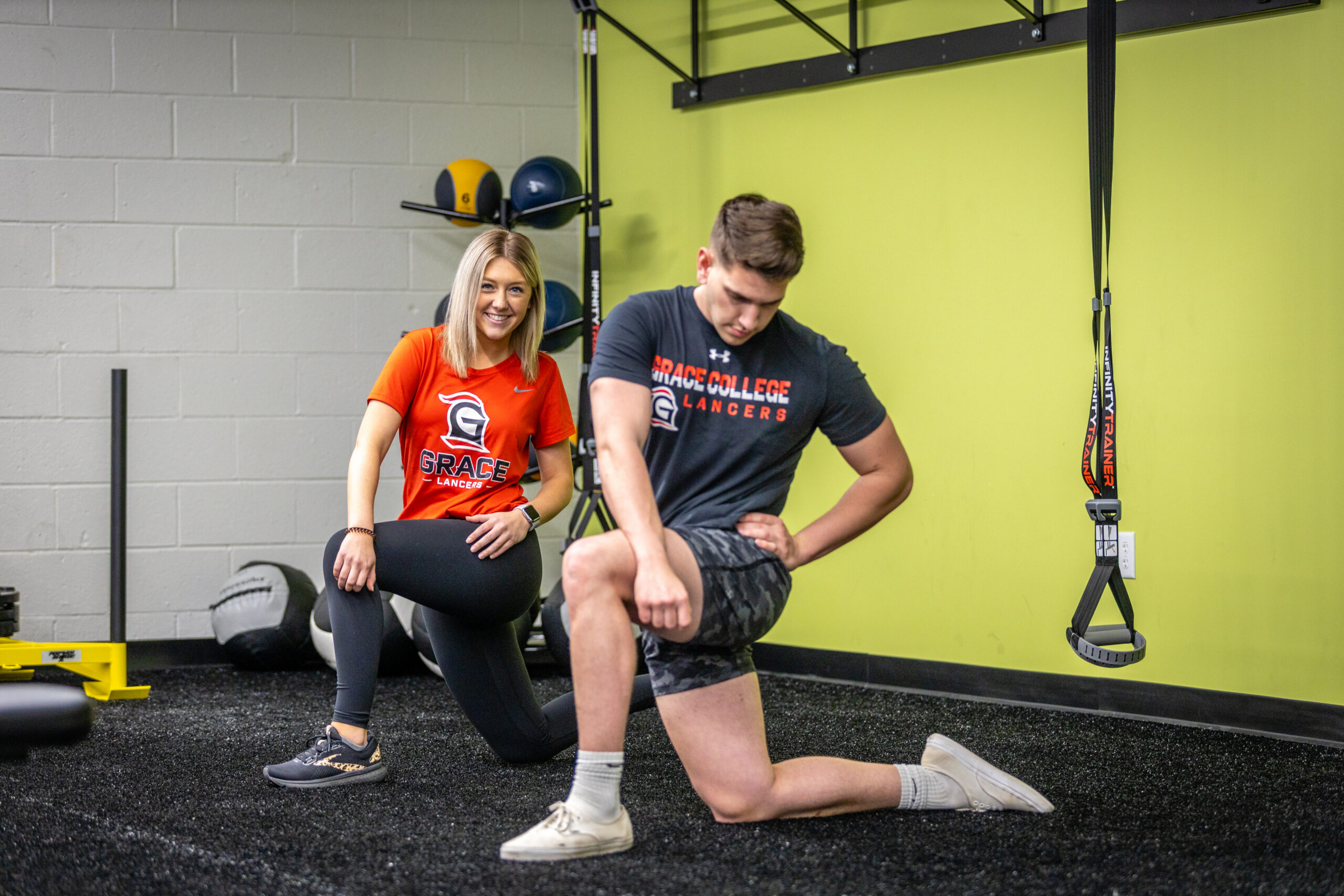
As an exercise science major at Grace, you’ll explore the relationship between the human body and physical activity, as well as best practices in coaching, training, and instructing others. After completing the degree, you’ll be prepared for graduate training or a post-undergraduate career in fields such as physical or occupational therapy, medicine, training and coaching, and education. At Grace College, the exercise science program is founded on the truth that God designed the human body for movement and activity. In our study, we honor the Creator and steward the body God has given us to use, move, and manage during this lifetime.
Introduction to Exercise Science is an entry level course that is designed to introduce students to the field of exercise science. This course will prepare students with knowledge and information on related health topics including: the history of exercise science, fitness assessment, nutrition, biology, exercise physiology, biomechanics, physical fitness, career opportunities, and beginning diagnostic tools. Three hours.
This course will investigate major topics in the study of lifestyle management. Topics included are: wellness, physical fitness, nutrition, disease, prevention, stress management, and consumerism. Three hours
This course is designed to guide students in the exploration of human anatomy, functional anatomy, fundamental movements and select movements. This will include an in-depth examination of the musculoskeletal framework through structure, function, and application in sport and exercise. Three hours.
Designed to provide information needed to manage the care of athletic injuries—from prevention, identification and assessment of injuries to interaction with players, parents and physicians. Geared toward those beginning careers in fitness or coaching, equipping them for management and implementation of injury and emergency situations. Prerequisites: EXS 2000 or BIO 1710/1720 or BIO 3210/3220. Three hours. This course has a fee for consumables used in its labs.
Principles of strength and conditioning draws students into a creative design and implementation of exercise for various areas of the body. A large majority of students pursuing careers dealing with exercise will encounter prescription weight training and physical conditioning. This course specifically addresses form, function, and programming for the upcoming fitness professional. Prerequisite: EXS 2000. Three hours.
This course prepares students to understand the fundamentals of proper fitness assessment and development of prescriptive exercise. The focus of the course is placed on assessment methodology, developing skills with modern test equipment, and incorporating collected data into exercise programs. Prerequisite: BIO 1710/1720. Three hours. This course has a fee for consumables used in its labs.
The design of the course is geared toward an in-depth study of the anatomy of the heart. Students will engage in assessment and testing of the heart in a resting and active state. An examination of abnormalities found in general, athletic, pediatric, women, and special populations. ECG testing and equipment skills proficiency along with data interpretation will be included as well. Prerequisites: BIO 2010/2020, or BIO 3210/3220. Three hours. This course has a fee for consumables used in its labs.
This course examines the structural components of the musculoskeletal, nervous, cardiovascular, respiratory, and endocrine systems. In addition, there is a comprehensive review of the body’s response to exercise, optimal work capacity during exercise training, and limitations due to environmental factors, age, sex, and physical health. Prerequisites: BIO 2040/2050 or BIO 3310/3320. Three hours. This course has a fee for consumables used in its labs.
This course introduces concepts of mechanics in relation to human movement, specifically in exercise, sport and physical activity. The primary focus is to gain understanding of mechanical and anatomical principles that control the link between human motion and structural mechanics in coordination with functional mechanisms. Prerequisites: BIO 2040/2050 or BIO 3310/3320. Three hours.
Principles of structure, function, and cellular organisms. Includes an introduction to the scientific method, characteristics of cytoplasm and basic cytology, energy acquisition and release and heredity. Also includes basic plant structure and function. Students must enroll concurrently in BIO 1620. Four hours.
A continuation of BIO 1610. Includes structure, function and interrelationships of the organ systems of animals with particular attention to the human body. Also includes introductory taxonomy, surveying the major groups of plants and animals. Prerequisite: BIO 1610/1620 or permission of the instructor. Students must enroll concurrently in BIO 1720. Four hours.
Functions and interrelationships of food nutrients throughout the life cycle of man. Includes digestion, absorption and metabolism of nutrients, as well as dietary evaluation and modification for physiological needs. Other areas of study include: role of social, psychological and cultural factors in food selection. Prerequisite: BIO 1610/1620 or consent of the biology program director. Three hours.
This course is designed for students pursuing a career in an allied health field (nursing, medical imaging, health and wellness, etc.) The class includes the study of basic gross and microscopic anatomy and the function of the body on cellular, tissue, and organ system levels. The class will include organization of the body, cytology, basic histology, and the study of several organ systems – integumentary, skeletal, muscular, nervous, and endocrine. Remaining body systems are covered in course BIO 2040. Students must enroll concurrently in BIO 2020. Four hours.
This course is designed for students pursuing a career in an allied health field (nursing, medical imaging, health and wellness, etc.) This course includes a basic study of the gross and microscopic structure of several major organ systems – endocrine, circulatory, respiratory, digestive, urinary, and reproductive. The other body systems are covered in course BIO 2010. Students must enroll concurrently in BIO 2050. Prerequisites: BIO 2010/2020 or consent of the instructor. Four hours.
A practical experience rotation in real-world settings. Students observe exercise science professionals in their prospective fields, and work on interpersonal skills at rotation settings. Pre-requisite: EXS 1000. Two hours.
The internship includes activity in a work environment, allowing the student to experience a hands-on opportunity to apply the skills and principles learned in class to a real-world, professional setting. Three hours of credit is given and is equivalent to approximately 120 hours in the work-place (or 40 work hours per credit hour). Prerequisites: EXS 1000 and EXS 2150. Three hours.
A course designed to give the student an opportunity to do individual research on a topic of interest in Exercise Science. Prerequisites: EXS 1000 and EXS 2150. Two hours.