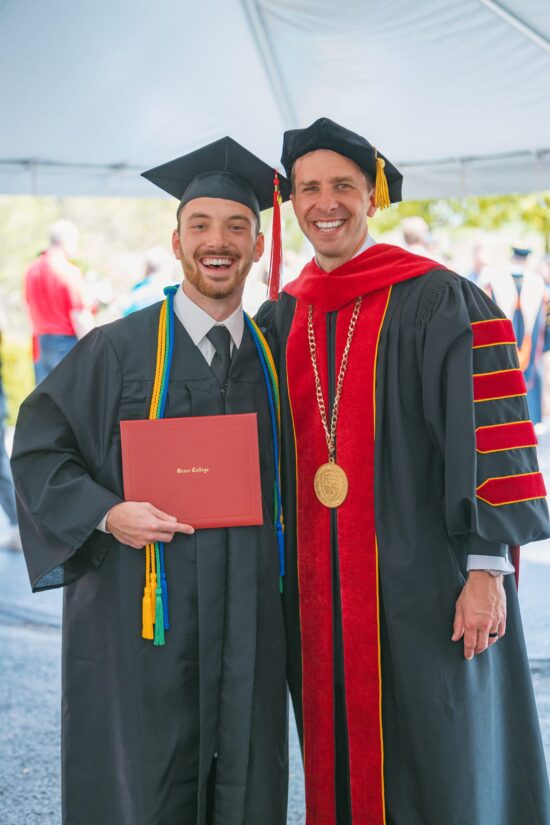

A Grace College English major is an invitation to join the lively and potentially life-changing conversation unfolding through centuries in the writing of diverse and gifted authors. Recognizing language as a gift from a creative God who has also endowed humans with creative potential, we seek to develop this potential and enhance our understanding of the power and pleasure of the written word. English majors enjoy small, discussion-oriented classes taught by talented faculty who are themselves practicing scholars, writers, and poets. Our program encourages students to develop a broad foundation through survey courses as well as to deepen their expertise through specialized electives on such topics as C.S. Lewis, the graphic novel, and young adult literature. English majors explore career interests through a senior capstone experience and internship.
This class serves as a gateway to the English major. It provides students with an intensive experience of discovering how literature makes meaning, acquaints students with the standard analytic modes of the discipline, and introduces students to literary scholarship at the college level. Three hours
A course for students who have mastered college-ready writing and whose academic or career objectives require professional-level writing skills. This class is designed to introduce students to theories of written communication; expand their rhetorical skills; improve the clarity, accuracy, grammar, and structure of their writing; and give them experience writing for different audiences across a variety of platforms (including digital media). In addition to extensive writing, the course involves interactive workshops where students learn to give and receive useful feedback to improve their own and others’ writing. Prerequisite: ENG 1100. Three hours.
A study of British literature from the Anglo-Saxon era through the eighteenth century. The course introduces the major political, historical, cultural, and literary influences of each period, and considers how these forces shaped individual literary texts and vice versa. Three hours.
A continuation of the previous course, concentrating on Romantic, Victorian, modernist, and postcolonial literature. The course introduces the major political, historical, cultural, and literary influences of each period, and considers how such forces shaped individual works of literature and vice versa. Three hours.
A survey of the development of American literature from colonial times through revolutionist, romantic, and transcendentalist literature up to mid-nineteenth century, across multiple genres. Three hours.
A continuation of the above course concentrating on the rise of realism, modernist, and postmodernist literature in multiple genres. Three hours.
An exploration of major works of world literature representing a variety of genres, periods, and/or cultures (excluding American and British). Three hours.
A study of the aesthetics and techniques of interpreting Shakespeare’s dramatic works across a range of media and cultural contexts. Though topics and works under consideration vary, sustained attention is given to the process of adapting canonical Shakespeare–as well as the political implications of doing so–in particular cultural settings. Special consideration is given to the local histories motivating contemporary adaptations. Three hours.
An introductory course emphasizing the process of creative writing in a variety of genres. The course offers a workshop approach with revision techniques and mutual criticism. Three hours.
This team-taught and interdisciplinary seminar is among students’ final educational experiences before degree completion. As such, its components allow students to showcase the academic abilities they have acquired through their degree program (through a thesis or project) and to think about and prepare for the next steps in their professional careers. Students participate in both interdisciplinary plenaries and discipline specific seminars. Students give a final presentation of their theses or projects at an interdisciplinary symposium. Three hours.
This course examines how digital technologies have transformed the ways in which stories are told. This course analyzes and discusses films, podcasts, online literature, interactive literature, social media as literature, video games, and story-based marketing. Throughout, the course explores essential features of narrative, and which of these features are effectively expressed in different media forms. These techniques are then applied in the major projects of the course, such as a podcast, a film or photo narrative, and/or an interactive online story. Three hours.
A survey of contributions in Christian literature including such authors as Dante, Milton, Bunyan, MacDonald, Chesterton, Tolkien, Sayers, and O’Connor. The course is designed to offer a focused integration of theology and literature. Three hours.
A course focusing on the works of C.S. Lewis, which may include both fiction and nonfiction writing. This course may focus exclusively on the writing of C.S. Lewis, or it may contextualize Lewis’s work in relation to works by J.R.R. Tolkien, the Inklings, and/or other writers. Three hours.
A study of women’s writing and critical perspectives. Topics and texts under consideration vary from class to class, but may focus on a specific theme, issue, genre, or time period. Three hours.
A study of works of fiction, poetry, drama, and/or nonfiction of the past 50 years. Topics under consideration vary from class to class but may include a chronological introduction to the development of contemporary literature, a particular genre, a consideration of a theme or issue common across a number of works, and/or a study of works in the context of historical, aesthetic, or cultural events. Three hours.
A study of the history, characteristics, genres, and cultural and pedagogical significance of young adult literature. This course also addresses issues related to the teaching and study of young adult literature such as censorship, diversity, and curriculum development. Three hours.
Content varies class by class, but features an intensive focus on a specific topic, genre, theme, period, culture or region, etc. Examples include Science Fiction & Fantasy, The Graphic Novel, etc. LIT 3750 is a cumulative course and may be taken more than once, provided the content is substantially different each time. Three hours.
A study of French literary genres, periods, and authors. Topics vary but may include a thematically-focused survey from medieval to contemporary French literature, the development of a genre, or a literary movement in a particular period. Students will develop a lexical and analytical toolkit for analyzing literary expression and will learn to substantiate and develop ideas through interpretative essays and classroom discussion. No prior knowledge of French language is required for students taking this as a literature elective; major reading and written assignments will be in English. See FRE 3800 for a cross-listed section of this course for French language students. Three hours.
A concentrated study of the works of a particular author (such as James Joyce), pair of authors (such as Hemingway & Fitzgerald or Austen & Bronte), or small group of authors (such as the Bloomsbury Group or the Shelley Circle). Topics and texts vary by class. LIT 4200 is a cumulative course and may be taken more than once, provided the content is substantially different each time. Three hours.
An intensive study of the major theories and schools of literary criticism, such as formalism, reader-oriented criticism, deconstruction, new historicism, etc. The course features representative readings and application to selected texts and is especially recommended for students considering a graduate degree in English. Three hours.
This seminar-style course offers an interdisciplinary approach to Irish literature, history, politics, and culture. This course may be organized around a particular period or theme, or it may be taught as a general survey. Three hours.
This course offers an interdisciplinary study of the political, literary, and intellectual development of European civilization from the decline of the Roman Empire to the Reformation of the sixteenth century. This course may be organized around a particular theme or taught as a general survey. Three hours.
A course that focuses on building skills in preparing copy for publishing in various formats. Topics include proofreading, copy editing, writing style, writing headlines and cutlines/captions, cropping photos, typography, and legal considerations. Basics of page design and layout will also be introduced. Three hours.