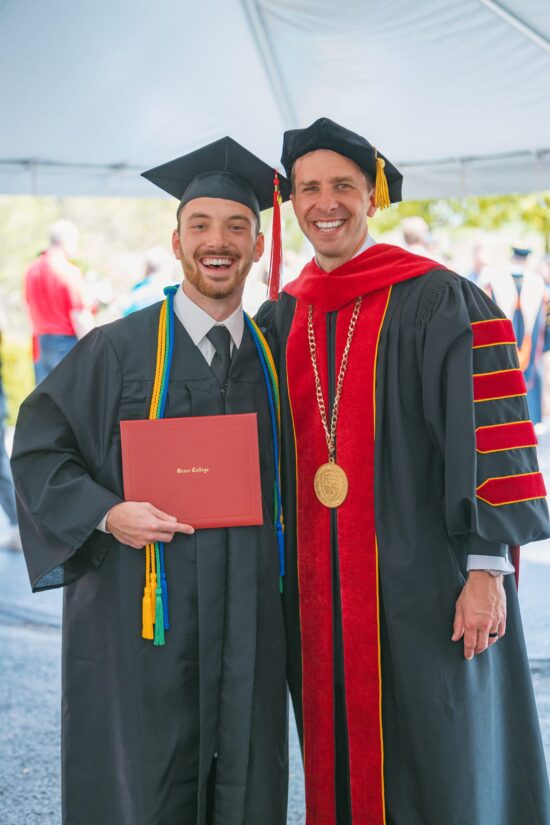

As a business education major at Grace, you will have the opportunity to make meaningful relationships with students and be equipped to provide quality instruction, engaging lesson plans, and differentiation to meet the specific needs of your students.
Grace College’s School of Education is founded on the ideology of “teacher as a moral practitioner.” We are deeply committed to instilling the principles of character, competence, and service in our future teachers. This comes from Micah 6:8, which states, “He has told you, O man, what is good; and what does the LORD require of you but to do justice, and to love kindness, and to walk humbly with your God?” Ultimately, we look to Jesus, the greatest teacher, as our guide.
An introduction to the profession of teaching. Learning experiences are structured both in and out of the classroom with the purpose of assisting the college student in making career decisions relative to the profession, e.g., to teach or not, at which level, and in which subject area. Both content and field experiences are aligned with the missions of Grace College and the School of Education. A grade of B- or better is required to continue on toward candidacy status. Three hours.
A study of the learner at all grade levels and the many factors affecting learning, including but not limited to, theories of learning, environment, heredity, cultural impact, discipline, classroom management, exceptionalities, and development. The measurement of academic aptitude and achievement is also covered. Practical application is stressed. Prerequisite: SED 1000. Three hours.
This course is designed for prospective teachers, elementary or secondary, and any interested persons working with children at home or in social agencies. The intent is to develop an introduction to children with exceptionalities and practical strategies to assist these children, especially in an educational setting. This course will examine the types of exceptionalities, the laws that apply to them, as well as adaptations and special services that are provided to them in a regular classroom setting and in alternative educational settings. Prerequisite: SED 1000. Three hours.
The course consists of cooperative teaching and learning. The instructor’s role is that of a facilitator, rather than a “giver” of knowledge. There are lectures, small and large group discussions of readings and related information, writing, and research focusing on issues of diversity in schools. To better appreciate the influence of culture on behavior and values, students explore their own diversity through written and/or group discussions and inquire into the cultural diversity of school populations in Indiana and surrounding regions. Among the topics included in this study are multicultural education, social classes and socioeconomic status, ethnicity and race, gender, religion, language, community involvement, curriculum, justice, privilege, and other relevant topics that relate to multicultural concerns. Prerequisite: SED 1000. Three hours.
This course provides you with a theoretical, research-based background for classroom instructional and assessment strategies you will be implementing in your teaching. Key issues discussed will include how people learn, instructional planning, how we successfully assess student learning, and how our instruction and assessment strategies can lead to improved student learning and increased motivation to learn. Prerequisite: SED 1000 & SED 2200. Three hours.
The purpose of this course is to develop a working knowledge of responsive instruction by applying differentiation strategies and Universal Design for Learning (UDL) principles. Students will learn to promote all students’ development, learning, and success through ongoing assessment that informs instruction. Multi-tiered systems within the general education setting will be explored. Students will learn technology skills and culturally responsive teaching to enhance student learning. Prerequisites: SED 2600, and candidacy status. Three hours.
This course presents best practices in classroom assessment, environment, and behavior management. Topics include relationship development, organization of the classroom learning environment, classroom procedure development, and approaches for managing individual and large group student behaviors. Various strategies to instruction and assessment will be explored. Candidates will develop lessons utilizing formative and summative assessment tools. Candidates will understand how these assessments inform the teaching and learning process. Prerequisites: candidacy status. Three hours.
This course is an introduction to critical thinking 1 as a fundamental process instrumental in applying philosophy to the craft of teaching. Various topics that deal with classroom concerns, student teaching experiences are discussed each week. Topics include: school law, interviewing, résumé construction, best practices, and classroom management. Candidates will complete the TWS designed to help the teacher education candidates continue their development as reflective practitioners by systematically documenting and analyzing student learning. This course is an introduction to critical thinking2 as a fundamental process instrumental in applying philosophy to the craft of teaching. The course is a systematic study of the philosophy of education and the ethics that undergird the profession. Both secular and Christian philosophical views are examined. Candidates also integrate elements of a chosen set of philosophical beliefs to sharpen their competence as a professional. Candidates interact with key stakeholders associated with the craft of teaching. Describing the work of moral practice is part of the activities of the course. Prerequisite: All SED course work completed, additional school requirements me. Three hours.
Includes full-time teaching experience for an entire semester as well as a seminar for majors during the experience. This course deals with a variety of topics and issues especially germane to candidates who are about to enter the teaching profession. Each candidate enrolled in this course will be required to complete a Teacher Work Sample and earn a passing score of C or higher. Prerequisites: All SED course work completed, additional school requirements met. Nine hours.
This course is offered to help the preservice teacher understand the special characteristics of early adolescents and adolescents and their school settings (middle and high school). Prerequisites SED 2200, SED 2600, candidacy status. Three hours.
This course is a presentation of the principles and techniques used in teaching business courses. Included is the study of various learning theories as well as various curriculum materials available. Field experience is involved. Prerequisites: SED 2200, SED 2600, SED 3600, candidacy status. Three hours.
Business Foundations serves as a broad overview and introduction to the field of business, as well as to the faculty of the School of Business and the academic requirements of the business program at Grace College. This course explores the foundational truths of the marketplace required for our system of business to function, although imperfectly, and serve the needs of those around us. The roles of freedom, economics, government, and faith will be key discussion points. The course examines these foundations from a biblical perspective to understand more fully how God would have us “do business.” Three hours
Principles of Management will expose students to the history of management thought. It also introduces students to the principles of management from the perspective of planning, organizing, leading, and controlling. Within a biblical framework, this course examines developments from scientific management to ethics, diversity, social responsibility, and globalization. Three hours.
This course provides a decision-oriented overview of marketing management in modern organizations. The objectives of the course are to provide a broad introduction to marketing concepts, the role of marketing in society and in the firm, and the various factors that influence marketing decision making. Three hours.
Develops an understanding and application of basic financial accounting principles. Emphasis on building and using basic financial statements and a manager’s use of accounting data. This course and ACC2120 together serve as the first year of accounting. Three hours.
The study of the managerial aspects of accounting and finance. Includes an in-depth study of the statement of cash flows, analysis of financial statements, product cost management, and cash budgeting. Prerequisite: ACC2110. Three hours.
In this course, students are introduced to Data Analytics by learning to retrieve data (SQL), prepare data (Excel), Analyze data using statistical methods, and report data. Prerequisite: BUS3050. Three hours.
This course exposes students to essential computer science topics including algorithms and introductory programming concepts including sequence, decision, and assignment and iteration. This course assumes no prior knowledge. (BS Core elective – cross listed with ISM 1150) Three hours.
The role of Christians in the marketplace is discussed with consideration of economic reasoning and methodology through examination of fundamental concepts in micro- and macroeconomics and through extension and applications of economic theory. Examination of the general functioning of a price system using fundamentals of supply and demand is evaluated. Exploration of the variety of market forms, theory of factor incomes and the effects of government intervention to promote efficiency and equity occurs. Three hours.
Basic legal principles which control modern business transactions. Deals with such topics as contracts, agencies, employment, negotiable instruments, property, sales, and business relations with government. Three hours.
Students advance their skill and confidence in using the workbook, database and output capabilities of Microsoft Excel. Focus is on understanding the advanced features of Excel and key issues of design and advanced output capabilities of spreadsheet programs. Three hours.
This foundational course explores corporate financial topics such as financial statement analysis, net present value, corporate valuation, the stock market, the bond market, financial governance, cash flow management, financing and debt strategies and the role of the CFO in managing a business. This course provides a practical approach to the discipline. Prerequisite: ACC2110. Three hours.
An awareness of the global business environment is essential. This survey course introduces various facets of international business, its application to the domestic concern, and national economy. Areas reviewed include the role and impact of multi-national corporations, cross cultural factors, and global strategies. Prerequisite: MGT2430. Three hours.
This course examines the biblical treatment of critical topics in business and economics. This examination provides a foundation for developing a framework for understanding business from a biblical perspective and for acting consistently within that perspective. The course develops a macro-level framework for the biblical understanding of the role of business organizations and the role of business professionals within those operations. This course complements the microlevel biblical frameworks developed in the discipline specific business courses. This content is designed to challenge the thinking of the student about how they will integrate their understanding of scriptural truth into creating an ethical life walk in a business setting. Prerequisite: Senior status (within two semesters of graduation) or permission. Three hours.