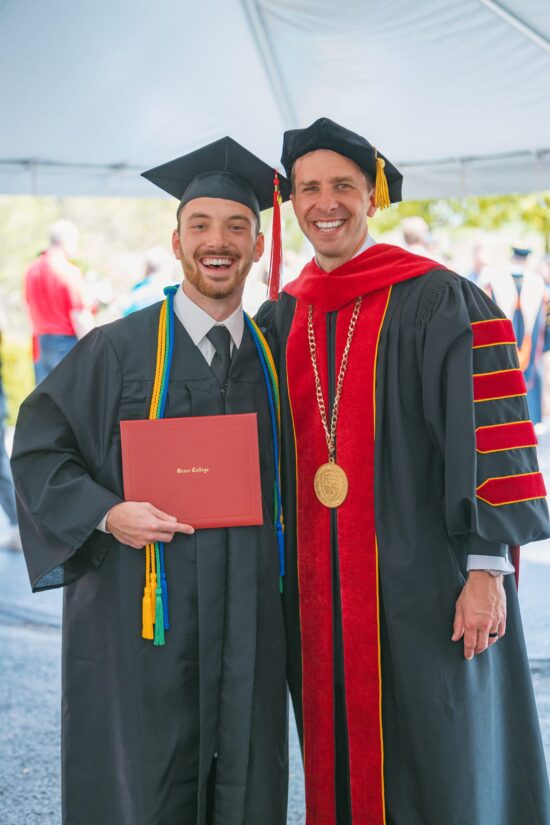

As a biology major at Grace College, you’ll explore living organisms and their biological processes, preparing for excellent work in everything from medical research to marine biology. We study biology with the foundation that God lies at the center of everything we hope to understand. As you peer at molecular life, you’ll learn to appreciate the fingerprint of an omniscient God whose “understanding is beyond measure.” (Ps. 147:5)
(1610) Principles of structure, function, and cellular organisms. Includes an introduction to the scientific method, characteristics of cytoplasm and basic cytology, energy acquisition and release and heredity. Also includes basic plant structure and function. Students must enroll concurrently in BIO 1620. Four hours.
(1620) The laboratory is designed to support BIO 1610 and must be taken concurrently with the course. This course has a fee for consumables used in its labs.
(1710) A continuation of BIO 1610. Includes structure, function and interrelationships of the organ systems of animals with particular attention to the human body. Also includes introductory taxonomy, surveying the major groups of plants and animals. Prerequisite: BIO 1610/1620 or permission of the instructor. Students must enroll concurrently in BIO 1720. Four hours.
(1720) The laboratory is designed to support BIO 1710 and must be taken concurrently with the course. This course has a fee for consumables used in its labs.
(2110) A study of the interaction of organisms with their physical environment and with each other. Particular focus will be on application of ecological concepts and field work in various local ecosystems. Students must enroll concurrently in ENV 2120. Four hours.
(2120) This laboratory is designed to support ENV 2110 and must be taken concurrently with the course. This course has a fee for consumables used in its labs.
A study of the basic principles that guide cellular composition, organization and function. Particular attention will be paid to understanding the molecular mechanism that underlies cell function. Topics studied in the course include, processes of energy extraction, membrane transport, cell surface communication, cell cycle and regulation, cell division, along with the study of specialized cells like gametes, lymphocytes, neurons, muscle cells, and cancer cells. The course includes hands-on laboratory experiments involving current procedures in cell and molecular biology. This course has a fee for consumables used in its labs. Prerequisite: BIO 2310 or consent of the instructor. Three hours.
A study of both in-depth classical genetics and underlying molecular mechanisms; also genetic mechanisms and processes, recombination, genetic interaction, and gene regulation. The process of expression of genetic information through protein synthesis is also considered in depth. The course includes hands-on laboratory experiments involving current procedures in molecular genetics. This course has a fee for consumables used in its labs. Prerequisite: BIO 2310 or consent of the instructor. Three hours.
This course is designed as a capstone course for science majors and is meant to teach valuable skills and give experience with tools needed for science careers or post-graduate education. Coursework is designed to challenge the student to integrate their current biological knowledge with a Biblical worldview, as well as to consider their future role as a Christ-follower in the workforce. Prerequisites: BIO 3110 and senior class standing, or consent of the instructor. Three hours.
This course has two parts: analytical chemistry and environmental chemistry. In the analytical portion of this course the student will be expected to master chemical measurements, experimental error, chemical equilibria, titrations, electrochemistry, and redox titrations. Additionally, the student will be introduced to environmental problems, sustainability, and green chemistry. Topics of interests will include air-pollution, global warming, fossil fuels, CO2 emissions, biofuels and renewable energy, water chemistry and eater pollution, use and misuse of nuclear energy, heavy metals, and pesticides and the problems they cause. Within the context of environmental challenges, analytical chemical techniques and practices are introduced. The class will investigate the environmental disasters experienced by Chernobyl, the Gulf of Mexico, and Three Mile Island. Statistical data analysis as well as analytical techniques and experiments in acid-base titration, buffer solutions, determining an equilibrium constant, potentiometry, electrochemistry, and liquid chromatography are investigated. Prerequisites: CHM 1710/1720. Three hours. This course has a fee for consumables used in its lecture-based labs.
(3210) This course is designed for students preparing for graduate studies in biology/medically related programs (medicine, physical therapy, pharmacy, etc.). The class includes an in-depth look at organization of the human body, cytology, histology, and the study of several of the major organ systems – integumentary, skeletal, muscular, nervous, and endocrine. A detailed study of the remaining body systems is covered in course BIO 3310/3320. Students must enroll concurrently in BIO 3220. Prerequisites: BIO 1710/1720 or consent of the instructor. Four hours.
(3220) The laboratory is designed to support BIO 3210 and must be taken concurrently with the course. This course has a fee for consumables used in its labs.
(3310) This course is designed for students preparing for graduate studies in biology/medically related programs (medicine, physical therapy, pharmacy, etc.). This course includes an in depth study of the gross and microscopic structure of several major organ systems – endocrine, circulatory, respiratory, digestive, urinary, and reproductive. A detailed study of the other body systems is covered in course BIO 3210/3220. Students must enroll concurrently in BIO 3320. Prerequisites: BIO 1710/1720 or consent of the instructor. Four hours.
(3220) The laboratory is designed to support BIO 3310 and must be taken concurrently with the course. This course has a fee for consumables used in its labs.
(4110) An introductory study of microorganisms dealing with the morphology, physiology and cultivation and identification of microbes and their role in the environment. Other areas studied include: immunology, genetics, metabolism, food, preservation, and diseases. Prerequisite: BIO 1610/1620 and BIO 1710/1720, or consent of the instructor. Students must enroll concurrently in BIO 4120. Four hours.
(4120) The laboratory is designed to support BIO 4110 and must be taken concurrently with the course. This course has a fee for consumables used in its labs.
Functions and interrelationships of food nutrients throughout the life cycle of man. Includes digestion, absorption and metabolism of nutrients, as well as dietary evaluation and modification for physiological needs. Other areas of study include: role of social, psychological and cultural factors in food selection. Prerequisite: BIO 1610/1620 or consent of the biology program director. Three hours.
(2410) Integrated study of plants as organisms. Deals with plant structure, physiology, development, genetics, ecology, and classification of major plant groups. Prerequisite: BIO 1010/1020 or BIO 1610/1620 or consent of the instructor. Students must enroll concurrently in BIO 2420. Four hours.
(2420) The laboratory is designed to support BIO 2410 and must be taken concurrently with the course. This course has a fee for consumables used in its labs.
(2510) Integrated study of animals as organisms. Deals with animal structure, physiology, development, genetics, ecology, and classification of major animal groups. Prerequisite: BIO 1010/1020 or BIO 1610/1620 or consent of the instructor. Students must enroll concurrently in BIO 2520. Four hours.
(2520) The laboratory is designed to support BIO 2510 and must be taken concurrently with the course. This course has a fee for consumables used in its labs.
This course uses modern biology in understanding the molecular and cellular basis for the formation of tissues, organs and organisms. Model organisms both classically and contemporarily used for understanding developmental biology will be discussed in detail, including: Xenopus, the zebrafish, the chick, the mouse and Drosophila, in addition to others. An understanding of the embryonic origins and development of the ectoderm, mesoderm and endoderm in humans is guided by recent scientific discoveries and experimentation. Students will also learn important bench skills being employed for studying and understanding development such as tissue staining, phase-contrast microscopy and real-time PCR. Moral and ethical issues facing Christians regarding preimplantation diagnosis, gene editing and stem cell technology are also discussed. Prerequisites: BIO 1610/1620 and 1710/1720. Three hours.
(4110) An introductory study of microorganisms dealing with the morphology, physiology and cultivation and identification of microbes and their role in the environment. Other areas studied include: immunology, genetics, metabolism, food, preservation, and diseases. Prerequisite: BIO 1610/1620 and BIO 1710/1720, or consent of the instructor. Students must enroll concurrently in BIO 4120. Four hours.
(4120) The laboratory is designed to support BIO 4110 and must be taken concurrently with the course. This course has a fee for consumables used in its labs.
(2140) The first half of a basic course covering the topics of kinematics, dynamics, energy, waves and sound. Prerequisite – One of the following: MAT 1120, MAT 1230/40, ACT Math score of at least 26, SAT Math score of at least 610, passing of department placement exam, or permission of the instructor. Students must enroll concurrently in PHY 2150. Four hours.
(2150) Designed to support PHY 2140 and must be taken concurrently with the course. This course has a fee for consumables used in its labs.
(1230) This course is a traditional introductory calculus course. We will study functions, limits, derivatives, and integrals. Applications of the derivative and the fundamental theorem of calculus will be particular highlights of this class as well as integrals and derivatives of logarithms and exponential functions. Students must enroll concurrently in MAT 1240. Four hours.
(1240) The laboratory is designed to support MAT 1230 and must be taken concurrently with the course. This course has a fee for consumables used in its labs.
A study of mental and emotional disorders, their symptomatology, classification, and methods of treatment. Special attention is given to a Christian approach to mental health. Three hours.
This course has two parts: analytical chemistry and environmental chemistry. In the analytical portion of this course the student will be expected to master chemical measurements, experimental error, chemical equilibria, titrations, electrochemistry, and redox titrations. Additionally, the student will be introduced to environmental problems, sustainability, and green chemistry. Topics of interests will include air-pollution, global warming, fossil fuels, CO2 emissions, biofuels and renewable energy, water chemistry and eater pollution, use and misuse of nuclear energy, heavy metals, and pesticides and the problems they cause. Within the context of environmental challenges, analytical chemical techniques and practices are introduced. The class will investigate the environmental disasters experienced by Chernobyl, the Gulf of Mexico, and Three Mile Island. Statistical data analysis as well as analytical techniques and experiments in acid-base titration, buffer solutions, determining an equilibrium constant, potentiometry, electrochemistry, and liquid chromatography are investigated. Prerequisites: CHM 1710/1720. Three hours. This course has a fee for consumables used in its lecture-based labs.
This is a course taught by a partner college/university.
This is a course taught by a partner college/university.
This is a course taught by a partner college/university.
This is a course taught by a partner college/university.
A 3-credit course that explores the biological mechanisms behind human diseases. It bridges the gap between basic anatomy and clinical medicine by examining how and why the body’s normal functions change when disease or injury occurs.
This is a course taught by a partner college/university.
This is a course taught by a partner college/university.
This is a course taught by a partner college/university.
This is a course taught by a partner college/university.
An overview of the sources, formats, and features of persuasion. Students analyze persuasion in political, religious, advertising, and everyday rhetorical settings. They also examine the nature of effective and ineffective persuasion. Students will make persuasive presentations. Prerequisite: COM 1100. Three hours.
This course is a study of the process of motivation and emotion and how they impact behavior and choices that people make every day. This course will study the research on the psychological and physiological aspects of motivations and emotion and the impact that those aspects have on behavior. The course will provide the student with a framework to view motivation and emotion that can help process difficult questions about human behavior such as “why as some people more emotional than others?” and “It is possible to create environments that increase the motivation of another human?”. Three hours.
This course is designed to guide students in the exploration of human anatomy, functional anatomy, fundamental movements and select movements. This will include an in-depth examination of the musculoskeletal framework through structure, function, and application in sport and exercise. Three credit hours.