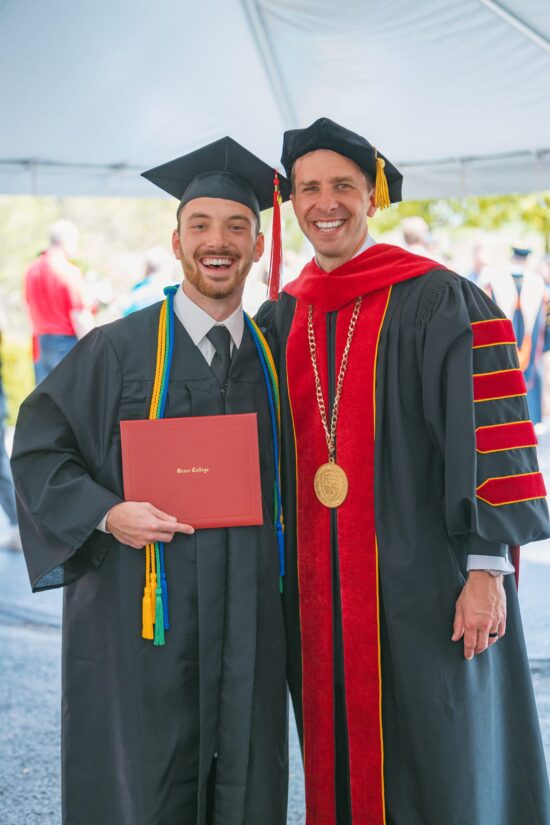

As an English education major at Grace, you will have the opportunity to make meaningful relationships with students and be equipped to provide quality instruction, engaging lesson plans, and differentiation to meet the specific needs of your students.
Grace College’s School of Education is founded on the ideology of “teacher as a moral practitioner.” We are deeply committed to instilling the principles of character, competence, and service in our future teachers. This comes from Micah 6:8, which states, “He has told you, O man, what is good; and what does the LORD require of you but to do justice, and to love kindness, and to walk humbly with your God?” Ultimately, we look to Jesus, the greatest teacher, as our guide.
This class serves as a gateway to the English major. It provides students with an intensive experience of discovering how literature makes meaning, acquaints students with the standard analytic modes of the discipline, and introduces students to literary scholarship at the college level. Three hours.
A course for students who have mastered college-ready writing and whose academic or career objectives require professional-level writing skills. This class is designed to introduce students to theories of written communication; expand their rhetorical skills; improve the clarity, accuracy, grammar, and structure of their writing; and give them experience writing for different audiences across a variety of platforms (including digital media). In addition to extensive writing, the course involves interactive workshops where students learn to give and receive useful feedback to improve their own and others’ writing. Prerequisite: ENG 1100. Three hours.
A study of British literature from the Anglo-Saxon era through the eighteenth century. The course introduces the major political, historical, cultural, and literary influences of each period, and considers how these forces shaped individual literary texts and vice versa. Three hours.
A continuation of the previous course, concentrating on Romantic, Victorian, modernist, and postcolonial literature. The course introduces the major political, historical, cultural, and literary influences of each period, and considers how such forces shaped individual works of literature and vice versa. Three hours.
A survey of the development of American literature from colonial times through revolutionist, romantic, and transcendentalist literature up to mid-nineteenth century, across multiple genres. Three hours.
A continuation of the above course concentrating on the rise of realism, modernist, and postmodernist literature in multiple genres. Three hours.
An exploration of major works of world literature representing a variety of genres, periods, and/or cultures (excluding American and British). Three hours
A study of the aesthetics and techniques of interpreting Shakespeare’s dramatic works across a range of media and cultural contexts. Though topics and works under consideration vary, sustained attention is given to the process of adapting canonical Shakespeare–as well as the political implications of doing so–in particular cultural settings. Special consideration is given to the local histories motivating contemporary adaptations. Three hours.
An introductory course emphasizing the process of creative writing in a variety of genres. The course offers a workshop approach with revision techniques and mutual criticism. Three hours.
This team-taught and interdisciplinary seminar is among students’ final educational experiences before degree completion. As such, its components allow students to showcase the academic abilities they have acquired through their degree program (through a thesis or project) and to think about and prepare for the next steps in their professional careers. Students participate in both interdisciplinary plenaries and discipline specific seminars. Students give a final presentation of their theses or projects at an interdisciplinary symposium. Three hours.
A study of the history, characteristics, genres, and cultural and pedagogical significance of young adult literature. This course also addresses issues related to the teaching and study of young adult literature such as censorship, diversity, and curriculum development. Three hours
HUM 3210 Irish Studies
HUM 3220 Medieval Studies
LIT 3100 Digital Narratives
LIT 3240 Christian Classics
LIT 3251 Genre Study: Poetry
LIT 3261 Genre Study: Drama
LIT 3265 Genre Study: Short Story
LIT 3420 C.S. Lewis
LIT 3430 Women Writers
LIT 3540 Topics in Contemporary Literature
LIT 3750 Selected Topics in Literature
LIT 3800 Topics in French Literature
LIT 4200 Major Author(s)
LIT 4350 Literary Theory
An introduction to the profession of teaching. Learning experiences are structured both in and out of the classroom with the purpose of assisting the college student in making career decisions relative to the profession, e.g., to teach or not, at which level, and in which subject area. Both content and field experiences are aligned with the missions of Grace College and the School of Education. A grade of B- or better is required to continue on toward candidacy status. Three hours
A study of the learner at all grade levels and the many factors affecting learning, including but not limited to, theories of learning, environment, heredity, cultural impact, discipline, classroom management, exceptionalities, and development. The measurement of academic aptitude and achievement is also covered. Practical application is stressed. Prerequisite: SED 1000. Three hours.
This course is designed for prospective teachers, elementary or secondary, and any interested persons working with children at home or in social agencies. The intent is to develop an introduction to children with exceptionalities and practical strategies to assist these children, especially in an educational setting. This course will examine the types of exceptionalities, the laws that apply to them, as well as adaptations and special services that are provided to them in a regular classroom setting and in alternative educational settings. Prerequisite: SED 1000. Three hours
The course consists of cooperative teaching and learning. The instructor’s role is that of a facilitator, rather than a “giver” of knowledge. There are lectures, small and large group discussions of readings and related information, writing, and research focusing on issues of diversity in schools. To better appreciate the influence of culture on behavior and values, students explore their own diversity through written and/or group discussions and inquire into the cultural diversity of school populations in Indiana and surrounding regions. Among the topics included in this study are multicultural education, social classes and socioeconomic status, ethnicity and race, gender, religion, language, community involvement, curriculum, justice, privilege, and other relevant topics that relate to multicultural concerns. Prerequisite: SED 1000. Three hours.
This course provides you with a theoretical, research-based background for classroom instructional and assessment strategies you will be implementing in your teaching. Key issues discussed will include how people learn, instructional planning, how we successfully assess student learning, and how our instruction and assessment strategies can lead to improved student learning and increased motivation to learn. Prerequisite: SED 1000 & SED 2200. Three hours.
The purpose of this course is to develop a working knowledge of responsive instruction by applying differentiation strategies and Universal Design for Learning (UDL) principles. Students will learn to promote all students’ development, learning, and success through ongoing assessment that informs instruction. Multi-tiered systems within the general education setting will be explored. Students will learn technology skills and culturally responsive teaching to enhance student learning. Prerequisites: SED 2600, and candidacy status. Three hours.
The content of this course builds from previous learning in SED 3310 and SED 3320. Candidates will understand reading difficulties and how the difficulties relate to the fourpart processor for word recognition. The MTSS process is introduced with the study and practice of explicit and systematic interventions utilizing encoding and decoding strategies. Candidates analyze data from Curriculum Based Measures and write a structured intervention plan aligned to the Science of Reading. Candidates will also grow in their understanding of explicit vocabulary and comprehension instruction. Candidates will apply knowledge through tutoring and in the elementary classroom setting. In addition, there are fifteen hours of clinical work in an elementary classroom. Candidates will teach whole class and small group literacy lessons. Prerequisites: SED 3310, SED 3320, candidacy status. Three hours.
Candidates spend Wednesday mornings in K-6 classrooms teaching whole and small group lessons. Candidates will foster learning through interactive read aloud, guided reading, and writing lessons. Candidates are supervised by college faculty and K-6 classroom teachers.
This course presents best practices in classroom assessment, environment, and behavior management. Topics include relationship development, organization of the classroom learning environment, classroom procedure development, and approaches for managing individual and large group student behaviors. Various strategies to instruction and assessment will be explored. Candidates will develop lessons utilizing formative and summative assessment tools. Candidates will understand how these assessments inform the teaching and learning process. Prerequisites: candidacy status. Three hours.
This course is an introduction to critical thinking 1 as a fundamental process instrumental in applying philosophy to the craft of teaching. Various topics that deal with classroom concerns, student teaching experiences are discussed each week. Topics include: school law, interviewing, résumé construction, best practices, and classroom management. Candidates will complete the TWS designed to help the teacher education candidates continue their development as reflective practitioners by systematically documenting and analyzing student learning. This course is an introduction to critical thinking2 as a fundamental process instrumental in applying philosophy to the craft of teaching. The course is a systematic study of the philosophy of education and the ethics that undergird the profession. Both secular and Christian philosophical views are examined. Candidates also integrate elements of a chosen set of philosophical beliefs to sharpen their competence as a professional. Candidates interact with key stakeholders associated with the craft of teaching. Describing the work of moral practice is part of the activities of the course. Prerequisite: All SED course work completed, additional school requirements me. Three hours.
Includes full-time teaching experience for an entire semester as well as a seminar for majors during the experience. This course deals with a variety of topics and issues especially germane to candidates who are about to enter the teaching profession. Each candidate enrolled in this course will be required to complete a Teacher Work Sample and earn a passing score of C or higher. Prerequisites: All SED course work completed, additional school requirements met. Nine hours.
This course is offered to help the preservice teacher understand the special characteristics of early adolescents and adolescents and their school settings (middle and high school). Prerequisites SED 2200, SED 2600, candidacy status. Three hours.
The course is a study of the philosophy, curriculum, and methods of teaching English on the secondary level, concentrating upon skills, knowledge, and dispositions which need to be possessed by the teacher and fostered among students. Tutorial and observational contact with the secondary school is an integral part of the course. Prerequisites: SED 2200, SED 2600, SED 3600, candidacy status. Three hours.