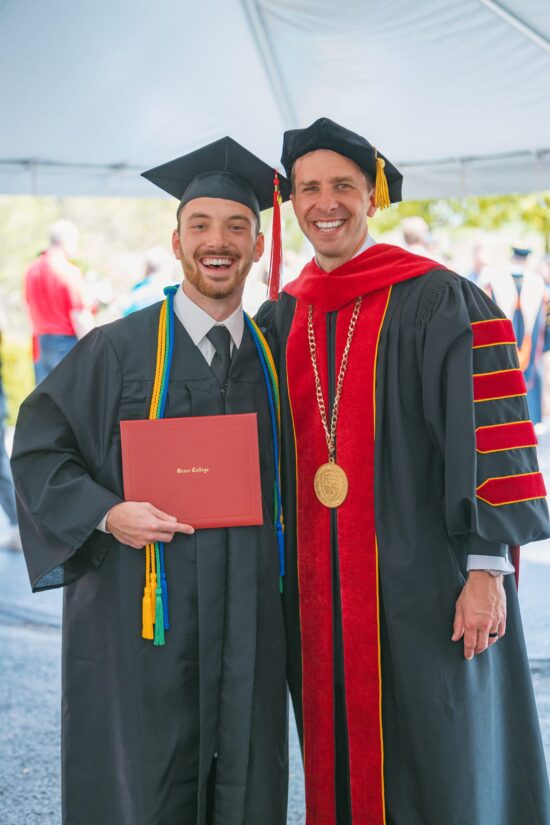

As an exercise science major at Grace, you’ll explore the relationship between the human body and physical activity, as well as best practices in coaching, training, and instructing others. After completing the degree, you’ll be prepared for graduate training or a post-undergraduate career in fields such as physical or occupational therapy, medicine, training and coaching, and education. At Grace College, the exercise science program is founded on the truth that God designed the human body for movement and activity. In our study, we honor the Creator and steward the body God has given us to use, move, and manage during this lifetime.
Introduction to Exercise Science is an entry level course that is designed to introduce students to the field of exercise science. This course will prepare students with knowledge and information on related health topics including: the history of exercise science, fitness assessment, nutrition, biology, exercise physiology, biomechanics, physical fitness, career opportunities, and beginning diagnostic tools. Three hours.
This course will investigate major topics in the study of lifestyle management. Topics included are: wellness, physical fitness, nutrition, disease, prevention, stress management, and consumerism. Three hours
This course is designed to guide students in the exploration of human anatomy, functional anatomy, fundamental movements and select movements. This will include an in-depth examination of the musculoskeletal framework through structure, function, and application in sport and exercise. Three hours.
This course is focused on providing a practical guide to coaching. The fundamentals needed to build a successful sport, personal training or team/group experience begin with basic principles such as practice planning, team building and program development. This class provides instruction to assist the student in possessing the skills to lead and coach individuals in their specific field. Three hours. Offered every other year.
Designed to provide information needed to manage the care of athletic injuries—from prevention, identification and assessment of injuries to interaction with players, parents and physicians. Geared toward those beginning careers in fitness or coaching, equipping them for management and implementation of injury and emergency situations. Prerequisites: EXS 2000 or BIO 1710/1720 or BIO 3210/3220. Three hours. This course has a fee for consumables used in its labs.
This course prepares students with skill and practice for group fitness instruction. The fundamentals needed to build a successful fitness class that engages the individual as well as the group. Students will begin building basic principles such as class planning, program
Principles of strength and conditioning draws students into a creative design and implementation of exercise for various areas of the body. A large majority of students pursuing careers dealing with exercise will encounter prescription weight training and physical conditioning. This course specifically addresses form, function, and programming for the upcoming fitness professional. Prerequisite: EXS 2000. Three hours.
This course addresses the wide variety of fitness trends rapidly entering the fitness market space. In a hands-on learning approach, students will learn to engage, experiment, and practice these fitness topics with guidance, empowering students to incorporate different trends and topics into their repertoire as fitness professionals. Three hours. Offered every other year.
This course prepares students to understand the fundamentals of proper fitness assessment and development of prescriptive exercise. The focus of the course is placed on assessment methodology, developing skills with modern test equipment, and incorporating collected data into exercise programs. Prerequisite: BIO 1710/1720. Three hours. This course has a fee for consumables used in its labs.
This course examines the structural components of the musculoskeletal, nervous, cardiovascular, respiratory, and endocrine systems. In addition, there is a comprehensive review of the body’s response to exercise, optimal work capacity during exercise training, and limitations due to environmental factors, age, sex, and physical health. Prerequisites: BIO 2040/2050 or BIO 3310/3320. Three hours. This course has a fee for consumables used in its labs.
This course is designed to give the student a broad introduction to general, organic, and biological chemistry. The lecture emphasizes general chemical concepts while the laboratory concentrates on techniques and data handling. Students must enroll concurrently in CHM 1020. Four hours.
Designed to support CHM 1010 and must be taken concurrently with the course. This course has a fee for consumables used in its labs.
Functions and interrelationships of food nutrients throughout the life cycle of man. Includes digestion, absorption and metabolism of nutrients, as well as dietary evaluation and modification for physiological needs. Other areas of study include: role of social, psychological and cultural factors in food selection. Prerequisite: BIO 1610/1620 or consent of the biology program director. Three hours.
This is an introductory course in public health designed for students pursuing careers in healthcare. Various aspects of public health are explored, including: infection disease, psychosocial behavior, environmental issues, and governmental policy-making. Epidemiological approaches to understanding public health data feature prominently throughout the course. Three hours.
Nutrient requirements and anthropometric aspects of nutrition for the following life stages: prenatal, pregnancy, lactation, infancy, childhood, adolescence, adult, and late adulthood. Exploration of the influences on the diet of each life cycle, including physiological, psychological, sociological, and cultural factors. Pre-requisite: CHM 1010/1020. Three hours.
Supporting and advancing athletic performance through nutritional strategies and therapies. Exploring specific nutritional needs among a variety of sports, as well as proper recovery methods and diet planning for optimizing body composition, speed, explosive and endurancebased performances. Examination of the risks and benefits of ergogenic supplements found in fitness and details concerning the effects of eating disorders. Students will frequently practice planning and strategizing diet and recovery methods for various sports and athlete profiles. Prerequisite: BIO 2210. Three hours.
This course evaluates current methodologies and professional techniques used to assess an individual’s nutritional status, lifestyle, and diet planning abilities. Students explore the utilization of nutritionally therapeutic interventions for disease prevention, counseling techniques for client support, building counselor-client rapport, and proper diet care documentation. Laboratory experience will provide numerous hands-on assessment opportunities and planning experiences. Prerequisite: EXS 3280. Three hours.
This course examines the biochemical relationship between food and chronic illness and introduces the use of nutrition as an intervention for pathological conditions, encompassing the complex relationship between nutrients and human cells. Additional focus includes the human microbiome, as well as nutrigenetics – how personal genetics impact nutrient uptake and utilization – and nutrigenomics – how food components impact genetic expression. Prerequisites: BIO 2210 and CHM 1010/1020. Three hours
A practical experience rotation in real-world settings. Students observe exercise science professionals in their prospective fields, and work on interpersonal skills at rotation settings. Pre-requisite: EXS 1000. Two hours.
The internship includes activity in a work environment, allowing the student to experience a hands-on opportunity to apply the skills and principles learned in class to a real-world, professional setting. Three hours of credit is given and is equivalent to approximately 120 hours in the work-place (or 40 work hours per credit hour). Prerequisites: EXS 1000 and EXS 2150. Three hours.
A course designed to give the student an opportunity to do individual research on a topic of interest in Exercise Science. Prerequisites: EXS 1000 and EXS 2150. Two hours.
This course is designed for students pursuing a career in an allied health field (nursing, medical imaging, health and wellness, etc.) The class includes the study of basic gross and microscopic anatomy and the function of the body on cellular, tissue, and organ system levels. The class will include organization of the body, cytology, basic histology, and the study of several organ systems – integumentary, skeletal, muscular, nervous, and endocrine. Remaining body systems are covered in course BIO 2040. Students must enroll concurrently in BIO 2020. Four hours
This course is designed for students pursuing a career in an allied health field (nursing, medical imaging, health and wellness, etc.) This course includes a basic study of the gross and microscopic structure of several major organ systems – endocrine, circulatory, respiratory, digestive, urinary, and reproductive. The other body systems are covered in course BIO 2010. Students must enroll concurrently in BIO 2050. Prerequisites: BIO 2010/2020 or consent of the instructor. Four hours.
This course is designed to help students both learn and then apply practical as well as theoretical information as it relates to the psychology of sport. The class will work to provide an understanding of how personlity, self-contempt, self-esteem, self-efficacy and other psychological characteristics relate to
participation and performance in sport and physical activities. The class will also investig te the impact of stress, motivation, goal-set ing, leadership and imagery on performance. The student will also learn common struggles and intervention strategies in working with athletes and recreational exercisers to enhance performance and participation. Three hours.
Students will develop an appreciation of the interaction and relationship between biological, psychological and social factors that influence one’s physical health and health behaviors. This course will examine lifestyle factors such as diet, exercise, stress, substance abuse and individual motivational factors. Additionally, this course will assess how psychological research, theories and principles apply to health promotion, health care issues and chronic illness. Three hours.
This course is a study of the process of motivation and emotion and how they impact behavior and choices that people make every day. This course will study the research on the psychological and physiological aspects of motivations and emotion and the impact that those aspects have on behavior. The course will provide the student with a framework to view motivation and emotion that can help process difficult questions about human behavior such as “why as some people more emotional than others?” and “It is possible to create environments that increase the motivation of another human?”. Three hours.