
Explore Over 100 Pathways to Your Future

Majors, Degrees & Programs
Academics
Photography Major at Grace College

Photography Course Descriptions

Photography Course Descriptions

As a photography major at Grace, you’ll be prepared to work in professional photography, applying the fundamentals of art and design to create work that not only fits your clients’ needs but exceeds their expectations.

You’ll engage with faculty who will encourage you to explore your relationship with truth as a photographer representing God’s Creation — from products, to landscapes, to other people.

Photography Requirements (24 Credits)

From the simple application of color to the complex devices that create illusionary space, this foundational lecture/studio course concentrates on the basic elements of two- and threedimensional design. Students will apply aesthetics and theoretical methods. Oral and written art criticisms are employed. Three hours.

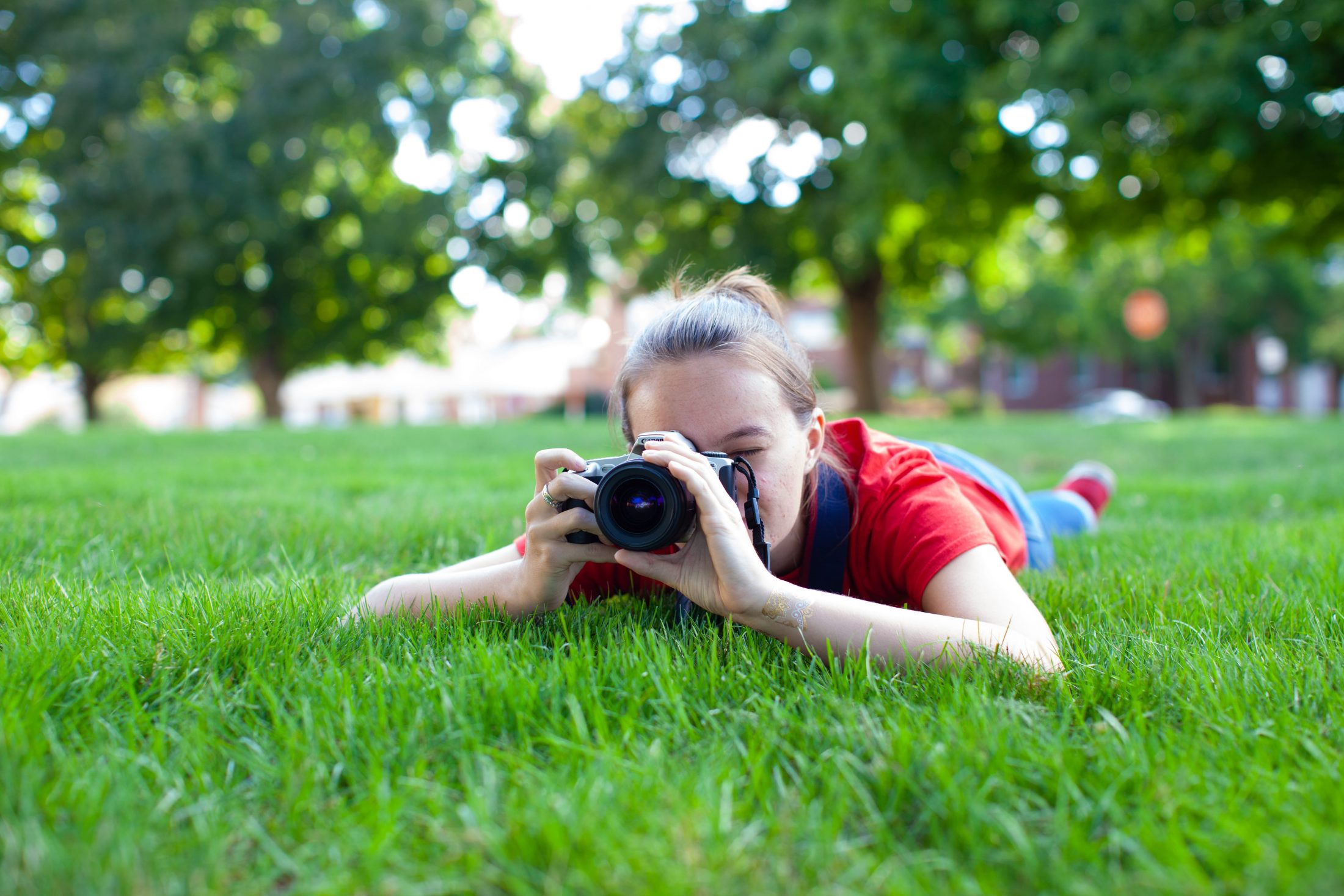
This course provides foundational instruction for the digital camera. Students will learn manual settings for capturing photographic images. DSLR camera required. Open to all majors. Studio fees apply. Three hours.

This course focuses on studio lighting techniques for product and portrait photography. DSLR (digital) camera required. Prerequisite PHT 2600. Studio fees apply. Three hours.

This course explores advanced alternative processes in film and digital application. Students will focus on conceptual abilities, photographic experimentation, and technical processes. Each student must provide a DSLR (digital); an SLR (film) camera or specialty camera may be utilized. Prerequisite: PHT 2600. Studio fees apply. Three hours.

An introductory course that uses manual and digital processes to explore visual communication theories and techniques. Utilizing Adobe software, this course introduces the development of visual skills through digital photo manipulation, illustrative rendering, and graphics file preparation. Relationships between content and social and cultural context will be explored. Prerequisite: ART 2110. Three hours.

Introductory training for in-studio video production editing techniques and processes. Three hours.

This course focuses on the integration of multiple forms of media requiring both creative and technical skills for visual imagery and messages. Visual media content includes digital photography, video, audio, and graphic software for dynamic formats. Three hours.

Focusing on the artist as author, this course examines the visual and structural components of sequential storytelling. Students will develop skills in creating storyboards, pictorial outlines, or scripted narratives to produce visual stories utilizing a chosen medium in their area of focus such as illustration, photography, design, or video/film studies. Students will explore historical and contemporary issues from multiple perspectives and create visual stories for a variety of audiences. Prerequisite ART 2110 or permission of instructor. Three hours.

Art History (6 Credits)

A contextual global survey of Non-Western and Western visual art. From pre-history to the Modern era, this course examines visual expressions that include original and indigenous art, architecture, and artifacts from the continental geographical locations of Africa, East and West Asia, the Americas, and Europe. Three hours. Open to all majors.
In context of contemporary visual art this course examines the complexities of aesthetics and meaning as expressed through cultural constructs. Analysis will consider the artwork and viewer, and how intention, production, and reception are interrelated. The study will include visual artworks created for cultural awareness relevant to our natural environment, urban settings, and place-making galleries. Research will explore contemporary visual artworks from continental geographical locations of Africa, East and West Asia, the Americas, and Europe. Three hours. Open to all majors.

Selected art historical or contemporary topics. Content may include studio-based research or experiential art that coincides with selected topic of study. (Example topic rotations: History of Christian Art and History of Photographic and Digital Arts.) Open to all majors. Repeatable with differing topics. Three hours.

Senior Portfolio Requirements (9 Credits)

During this course, students work to develop an understanding of their discipline within a professional context and complete a capstone project for their professional portfolio. Students research and examine social, cultural, and economic contexts to inform their work. Prerequisites: Upper-level student or permission of instructor. Three hours.

During this course, students begin curating their final senior portfolios for presentation, including professional and peer review. Students also conduct research to develop an understanding of the professional aspects of their specific areas of discipline. Requires senior status or department approval. Three hours.

A senior capstone course for students majoring in any of the following visual arts including art and visual culture, eco-art (ecological art), photography, and visual communication design. The focus will be on executing individual stylistic approaches in reaching visual communication goals for the final senior portfolio, thesis exhibit, and installation. Three hours.

Experiential Learning (3 Credits)

Qualified visual arts majors receive on-the-job training at a cooperating organization. Prerequisite: Approval by program director and department chair. Three hours.

An experiential focused research in the photographic arts with specific study applicable to studio, analysis, history, or technology. By consent of department chair only. May be repeated for credit. Three hours.

Photography Electives (9 Credits)

An introductory course focusing on developing fundamental drawing skills and improving visual perception. The primary emphasis is on structural drawing and composition using dry media. A variety of studio exercises will be used. Three hours.

The study and application of acrylic paint media with an emphasis on aesthetic and technical knowledge. Skill advancement through the development of final artworks from original concept, process, and completion will be expected. The application of personal style will be employed. Prerequisite: ART 1200 and ART 2110 or permission of instructor. Three hours.

Students learn advanced techniques and skills in watercolor media application. Exploration of themes will include original concepts such as landscape, still life, and portraiture. Prerequisite: ART 2400, or permission of instructor. Three hours.

This course explores unique expressive applications of the student’s drawing ability through digital technology. Included are experiments in structural digital drawing, sketching, and painting utilizing Procreate. Students may use other digital software for assignment completion. Prerequisite: ART 1200 and ART2110. Three hours.

Advanced level synthesis in making art forms with cross-discipline or community integration that results in artwork developed for a final portfolio, exhibition, community or public installation. Prerequisite: Second or third year visual arts student, or permission of instructor. Three hours.

This advanced level visual arts research course focuses on an individual topic selected by the student and results in a visual arts product that contributes to the student’s senior portfolio and art/design exhibition. This may include traditional dry, wet, mixed, or digitized media integrating major and minor fields of studies. Prerequisite: completion of major course requirements, approval of research proposal by lead faculty, and permission of department chair. Three hours. May be repeated up to 6 hours.

This is an introductory studio course in the varied principles of three-dimensional design. Projects explore traditional and experimental materials. Students will be expected to supply a variety of materials such as found or recycled objects for re-purposing into art forms. Studio fees may apply. Prerequisite ART 2110. Three hours.

Advanced level course that examines contemporary issues within the context of the student’s major focus and results in a specialized product for the student’s portfolio and senior thesis exhibit. Three hours.

Students will acquire basic theories and practices of lighting for stage, theatre, and live production. Covered topics will include energy needs, focusing, optics, moving lights, color theory, and various control surfaces. Three hours.

Students will learn signal flow through sound reinforcement systems. Basics of acoustics and room design will be investigated. Use of real-time analyzing software and basic equipment diagnosis will be investigated. Hands-on mixing opportunities will be given on industry standard equipment. Students will gain skills in running audio for different settings and develop problem solving skills to resolve audio-related issues. Three hours.