
Explore Over 100 Pathways to Your Future

Majors, Degrees & Programs
Academics
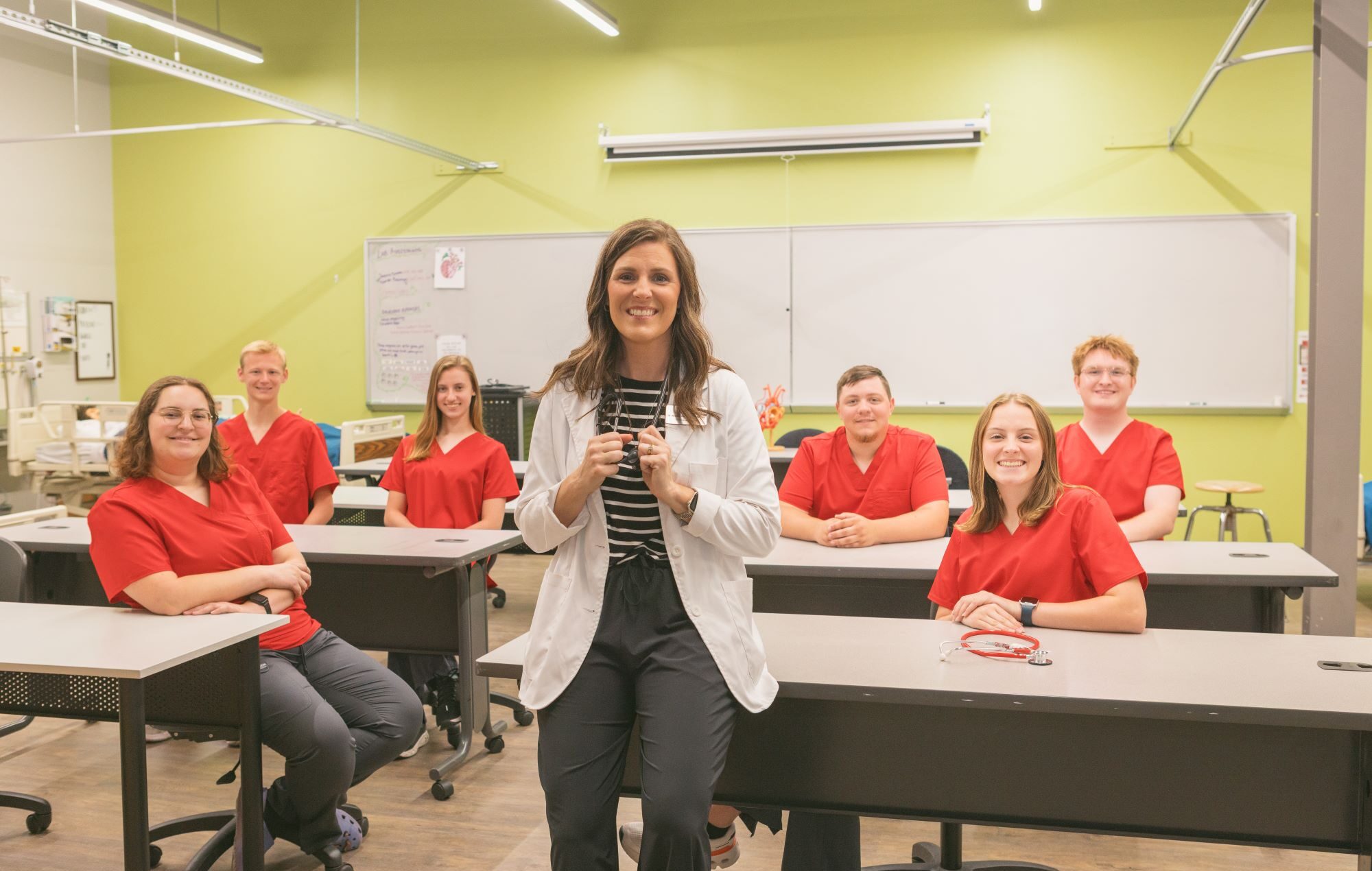
Grace College offers a Bachelor of Science in Nursing (BSN) at a Christian college. Our Nursing BSN prepares for NCLEX-RN integrating faith. Professor Kristen Richmond in class.

Nursing Course Descriptions

Nursing Course Descriptions

Grace College offers a Bachelor of Science in Nursing (BSN) at a Christian college committed to integrating faith, compassion, and clinical excellence. Our BSN nursing program prepares students for the NCLEX-RN while developing nurses who serve with Christ-centered care.

Beginning in the fall of 2026, students will be able to enroll in Grace’s state-accredited nursing curriculum, which prepares them to care for patients of all ages, conditions, and backgrounds as a servant of Christ.

Our nursing BSN is grounded in the truth that Christian nurses act as the hands and feet of Jesus by providing compassionate care. In our holistic, faith-integrated BSN nursing program, you will experience academic rigor as your heart for service grows.

Nursing Major Courses (61 Credits)

A course for the entry-level student who has been identified as pre-nursing. Exposure to the frameworks and theories of nursing, technology guiding and enhancing nursing care, patient safety, introduction to the nursing process, clinical judgement model, and beginning skills. Prerequisite: BIO 2010/2020, ENG 1100.Three credits.

A course focused on the basic principles of nursing from a theoretical and evidence base. Further application of the nursing process and clinical judgement. Develops fundamental skills needed to implement nursing care and establishes a caring presence with therapeutic communication for the adult and elderly patient. Prerequisite: BIO 2040/2050, CHM 1010/1020, NSG 1100, PSY 1100. Five credits, 80 clinical/lab hours.

A course focused on foundational knowledge and skills for nurses to provide holistic care for adult patients with a variety of common chronic medical and surgical conditions, focus on health promotion, disease prevention, preoperative, intraoperative, and postoperative (surgical) care. Prerequisite: NSG 2000/2010, BIO 2700/2710. Corequisite: NSG 2400/2410, NSG 2600, NSG 2800. Five credits, 80 clinical hours.

A course focused on providing students with a comprehensive understanding of mental health disorders, their causes, symptoms, and treatment options, equipping them with the necessary knowledge and skills to provide safe and effective nursing care to individuals experiencing mental health challenges, including assessment, therapeutic communication, medication management, and crisis intervention and de-escalation strategies, while emphasizing the importance of a holistic approach to patient care across the lifespan. Prerequisite: NSG 2000. Corequisite: NSG 2200, NSG 2600, NSG 2800. Four credits, 40 clinical hours
A course focused on providing the student with the theoretical knowledge and practical skills necessary to conduct comprehensive physical examinations on patients, including collecting health history, performing systematic head-to-toe assessments, interpreting findings, and documenting data accurately to proficiently utilize appropriate assessment techniques for diverse patient populations across various healthcare settings. Prerequisite: NSG 1100, NSG 2000 Corequisite: NSG 2200, NSG 2400, NSG 2800. Two credits. 

A course focused on foundational pharmacologic principles of various drug classifications to ensure safe medication administration to a variety of patient populations. Through the incorporation of the cellular aspects and manifestations of disease processes, students will develop a greater understanding of the pharmacodynamics, pharmacokinetics, and therapeutic uses of medication classifications. Prerequisite: BIO 2700. Corequisite: NSG 2200, NSG 2400, NSG 2600. Three credits.

A course focused on continuing foundational knowledge and skills for nurses to provide holistic care for adult patients with a variety of common chronic medical and surgical conditions. Prerequisite: NSG 2200, NSG 2400, NSG 2600, NSG 2800. Corequisite: NSG 3300, NSG 3500. Five credits, 80 clinical hours.

A course focused on care of the adult patient suffering from various acute disease processes with the nursing process, interprofessional collaboration, and use of evidence-based practice to provide holistic patient care. Prerequisite: NSG 3000, NSG 3300, NSG 3500. Corequisite: NSG 3400, NSG 3600. Five credits, 80 clinical hours.

A course focused on the holistic care of the pregnant woman, newborn, and new family. Topics covered include prenatal care and health, labor and delivery, postpartum recovery, complications of the labor and delivery process, newborn care, and women’s health. Prerequisite: NSG 2200, NSG 2400, NSG 2600, NSG 2800. Corequisite: NSG 3000, NSG 3500. Four credits, 40 clinical hours. 

A course focused on the holistic healthcare needs of the child and family. Topics covered include growth and development of the child from birth to adolescence, disease processes of the pediatric patient through each body system, while using a family-centered and interprofessional approach. Prerequisite: NSG 3000, NSG 3300, NSG 3500. Corequisite: NSG 3200, NSG 3600. Four credits, 40 clinical hours.

A course focused on continuation of pharmacologic principles of various drug classifications to ensure safe medication administration to more complex patient populations. Through the incorporation of the cellular aspects and manifestations of disease processes, students will develop a greater understanding of the pharmacodynamics, pharmacokinetics, and therapeutic uses of medication classifications. Prerequisite: NSG 2200, NSG 2400, NSG 2600, NSG 2800. Corequisite: NSG 3000, NSG 3300. Two credits.

A course focused on in-depth instruction on the assessment, management, and care of critically ill patients across various life-threatening conditions, equipping students with the necessary knowledge and skills to provide specialized nursing care within intensive care units (ICUs) and other critical care settings, focusing on advanced clinical decision-making, complex medical interventions, and patient/family support in high-acuity situations. Prerequisite: NSG 3200, NSG 3400, NSG 3600. Corequisite: NSG 4300, NSG 4500. Five credits, 80 clinical hours.

A course focused on equipping nurses with the theoretical knowledge and practical skills necessary to lead and manage the patient care team within the healthcare setting. Topics covered include leadership styles, organizational theories, change management, staff delegation, budget management, prioritization of clinical care, quality improvement, and ethical decision-making, all while applying these concepts to optimize patient care and staff satisfaction within diverse healthcare environments. Prerequisite: NSG 4000, NSG 4300, NSG 4500. Corequisite: NSG 4400, NSG 4600. Five credits, 80 clinical hours.

A course focused on providing nursing students with an in-depth understanding of community-based healthcare practices. It focuses on the role of the nurse in promoting health, preventing illness, and providing care across diverse community settings. The course explores key concepts such as community health assessment, epidemiology, health promotion, disease prevention, and the social determinants of health. Students will gain practical experience through fieldwork, allowing them to assess the health needs of specific populations and develop tailored nursing interventions. Prerequisite: NSG 3200, NSG 3400, NSG 3600. Corequisite: NSG 4000, NSG 4500. Four credits, 40 clinical hours.

A course focused on providing an introduction to evidence-based practice (EBP) research, principles, and their application to nursing and healthcare. Students will explore the integration of the best current evidence, clinical expertise, and patient values to enhance clinical decision-making and improve patient outcomes. The course covers methods for formulating clinical questions, systematically searching for and appraising evidence, and implementing findings into practice. Prerequisite: MAT 2000, NSG 3200, NSG 3400, NSG 3600. Corequisite: NSG 4000, NSG 4300. Three credits. 

A course focused on solidifying clinical judgement and final preparation for NCLEX testing through computerized practice exercises and predictor testing. Prerequisite: NSG 4000, NSG 4300, NSG 4500. Corequisite: NSG 4200, NSG 4400. Two credits.

Core Science Courses (16 Credits)

This course is designed for students pursuing a career in an allied health field (nursing, medical imaging, health and wellness, etc.) The class includes the study of basic gross and microscopic anatomy and the function of the body on cellular, tissue, and organ system levels. The class will include organization of the body, cytology, basic histology, and the study of several organ systems – integumentary, skeletal, muscular, nervous, and endocrine. Remaining body systems are covered in course BIO 2040. Students must enroll concurrently in BIO 2020. Four hours.

This course is designed for students pursuing a career in an allied health field (nursing, medical imaging, health and wellness, etc.) This course includes a basic study of the gross and microscopic structure of several major organ systems – endocrine, circulatory, respiratory, digestive, urinary, and reproductive. The other body systems are covered in course BIO 2010. Students must enroll concurrently in BIO 2050. Prerequisites: BIO 2010/2020 or consent of the instructor. Four hours.

This course is designed to give the student a broad introduction to general, organic, and biological chemistry. The lecture emphasizes general chemical concepts while the laboratory concentrates on techniques and data handling. Students must enroll concurrently in CHM 1020. Four hours.

An organ systems approach to the study of disease-related microorganisms intended for the nursing major. The foundations of microbiology are presented through the lens of disease processes as bacterial, viral and parasitic infections relevant to health professionals are explored. Other course topics include: host-parasite interaction; virulence factors; hospital and community acquired infections; mechanisms of gene transfer; disinfection; antimicrobial drugs; and, immunology. Prerequisite: BIO 1010/1020; or BIO 1610/1620; or BIO 2010/2020; or consent of the instructor. Students must enroll concurrently in BIO 2710. Four hours.