Writing
How is AI impacting your field?
The impact of AI on higher education in the humanities has been positive in some ways, and AI can serve many practical purposes.
“There are many ways in which AI is beneficial to my field,” said Rich. “For example, AI-powered research tools make it much easier and faster to locate, identify, and organize relevant scholarly research. It allows us to analyze texts in new and different ways and reflect more deeply and critically on their own and others’ interpretations.”
What makes a person’s skills in this degree better than AI?
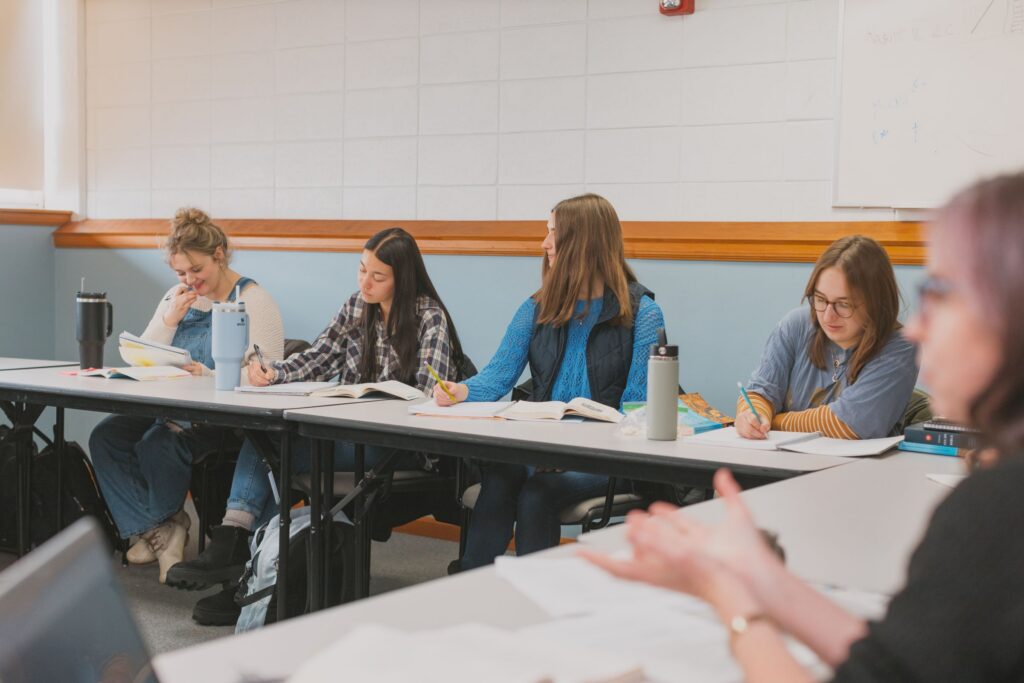
“While AI-powered tools can be helpful, at the same time, a large part of what attracts students to our English program is the opportunity to learn in community, to share in the experience of reading and discussing literature and writing together, face-to-face with other humans,” shared Rich. “This part of the field hasn’t changed — in fact, many people (including Anthropic’s co-founder, Daniela Amodei, herself an English major) recognize that the humanities are even more valuable in the age of AI.”
Another important distinction of a face-to-face program is the chance to have a faith-based perspective. Grace’s Christian foundation does not cloud our vision of managing AI, but actually gives us a clear view on how to use it ethically, along with increased confidence in our students to use this tool properly.
An article in Christian Scholar’s Review states, “Christian colleges aren’t just preparing students for their first job; they’re laying a foundation for a lifetime of faithful service in a rapidly changing world. They’re forming graduates who can not only work in the age of AI but who can bring biblical wisdom to bear on the ethical challenges AI presents.”
Is an undergraduate degree still necessary?
As for writers, Rich provides a hopeful response concerning the impact of AI on higher education: “The English major is actually becoming more valuable as employers prioritize new hires with strong communication and critical thinking skills over technical training that quickly becomes obsolete. It’s true that AI can generate content, but people have quickly and pretty decisively rejected ‘AI slop.’ Creating and curating content that really connects with and moves people requires creativity, empathy, nuance, sound judgment, and an appreciation for unpredictability and ambiguity. These are things that AI struggles with and human English majors excel at.”
Rich’s words echo an article from the U.S. News Bureau and World Report, which states that students should focus on gaining versatile skills, such as communication and critical thinking, instead of choosing their major based on profit or projected job stability. While completing the technical training for your degree, make sure your school teaches you how to provide the “humanness” your clients and viewers are seeking. This is unreplicable by AI.
Is a College Degree Worth It?
At Grace, you’ll be instructed on how to use technology effectively, but you’ll also find personal connection in one-on-one conversations with professors, deep relationships with your peers, and strong commitment to faith. A Christian liberal arts education, by definition, centers ethics and critical thinking in your education. These are vital when handling AI.
Rich sums up our vision on the impact of AI on higher education well: “At Grace, our understanding of authorship and creativity is rooted in God, who is the author and creator of all things. Because we are made in God’s image, we get to participate in creating with our unique, God-given voices. Because AI is a rapidly evolving area, we want our graduates to be flexible thinkers who understand and adapt to new technologies rather than become dependent on a particular tool.”
Our Creator gave us the ability to create and be like Him, so do not stop creating simply because there is a tool that can do it for you. At the same time, be grounded in the fact that, in the midst of the technological age, God never changes. He is the same yesterday, today, and tomorrow, and we can count on Him to guide our steps.