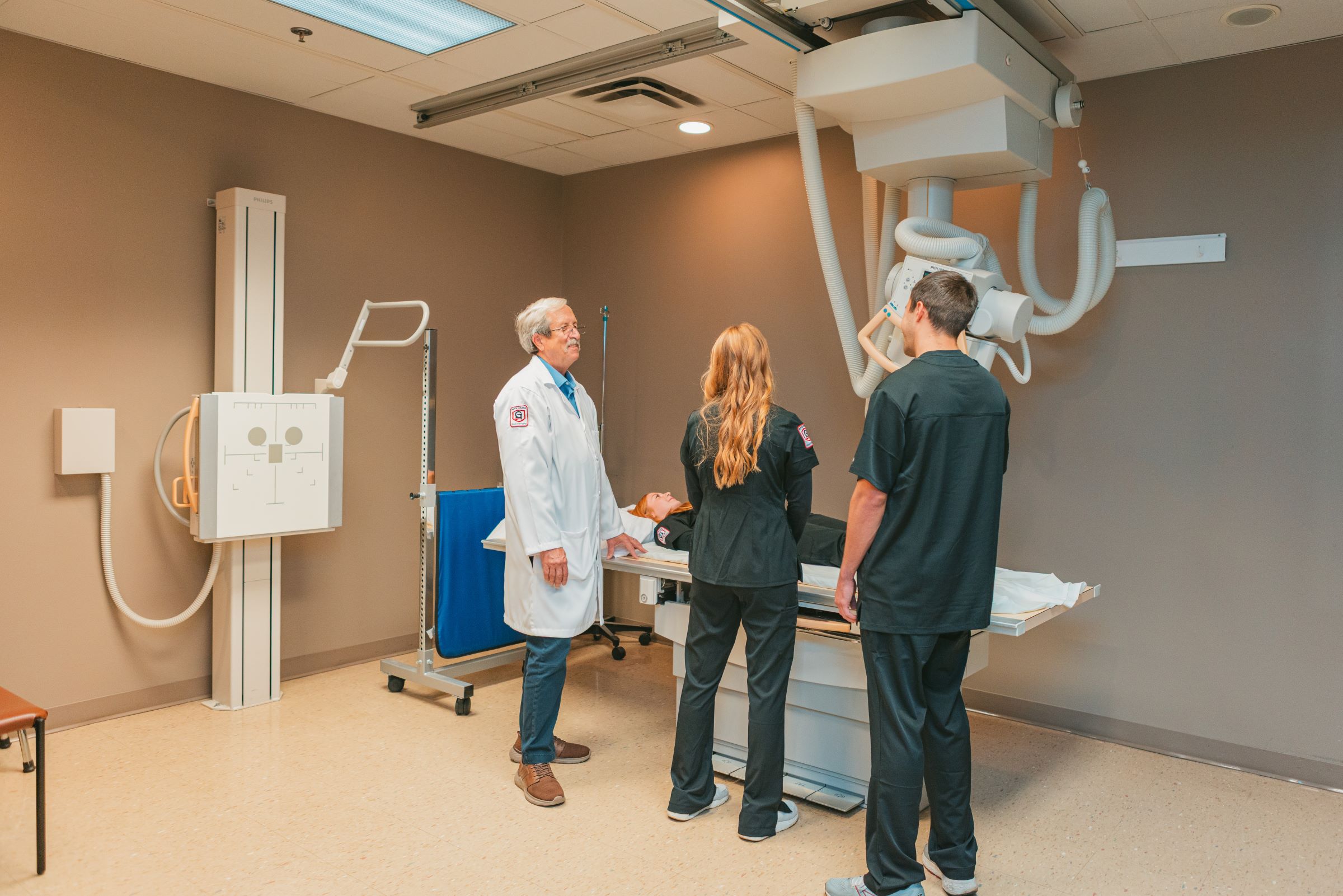
The B.S. in Medical Imaging with a concentration in Radiologic Technology prepares you to take high-quality diagnostic images, keep patients safe, and serve with compassion. Beyond the technical skills, you’ll take courses in leadership and communication, professionalism, information systems, and productivity and assessment, preparing you to grow into lead and management roles over your career.
An introductory level course which surveys terms and phrases commonly used in the medical setting. Emphasis is placed on understanding word roots which enables students to synthesize understanding of both familiar and unfamiliar medical language. Word elements from major body systems, medical procedures (including laboratory and diagnostic) and pharmacotherapeutics are covered by this course. One credit.
This course is designed for students pursuing a career in an allied health field (nursing, medical imaging, health and wellness, etc.) The class includes the study of basic gross and microscopic anatomy and the function of the body on cellular, tissue, and organ system levels. The class will include organization of the body, cytology, basic histology, and the study of several organ systems – integumentary, skeletal, muscular, nervous, and endocrine. Remaining body systems are covered in course BIO 2040. Students must enroll concurrently in BIO 2020. Four credits.
BIO 2020 Anatomy and Physiology I Lab
The laboratory is designed to support BIO 2010 and must be taken concurrently with the course. This course has a fee for consumables used in its labs
This course is designed for students pursuing a career in an allied health field (nursing, medical imaging, health and wellness, etc.) This course includes a basic study of the gross and microscopic structure of several major organ systems – endocrine, circulatory, respiratory, digestive, urinary, and reproductive. The other body systems are covered in course BIO 2010. Students must enroll concurrently in BIO 2050. Prerequisites: BIO 2010/2020 or consent of the instructor. Four credits.
BIO 2050 Anatomy and Physiology II Lab
The laboratory is designed to support BIO 2040 and must be taken concurrently with the course. This course has a fee for consumables used in its labs.
This course covers the biological basis for disease within the human body. Pathological conditions are presented by organ system, including disorders caused by injury, infection, deficiency, and genetics. A review of basic anatomy and physiology is included with each body system in order to contrast normal and diseased states of tissues and organs. The origin of each disease is analyzed down to a cellular or tissue level to provide root understanding of the cause of human disease. Prerequisite: BIO 1710/1720 or BIO 2040/2050. Three credits
This course is designed to give the student a broad introduction to general, organic, and biological chemistry. The lecture emphasizes general chemical concepts while the laboratory concentrates on techniques and data handling. Students must enroll concurrently in CHM 1020. Four credits.
CHM 1020 Introduction to Chemistry Lab
Designed to support CHM 1010 and must be taken concurrently with the course. This course has a fee for consumables used in its labs.
This course is for licensed Radiation Therapists and imaging professionals. This course will introduce the learner to professional development, professional ethics, and workplace relationships. Emphasis will be placed on the healthcare work environment.
This course provides a detailed study of the central nervous system, thorax, abdomen, pelvis, and musculoskeletal system as demonstrated on magnetic resonance imaging and computed tomography. Anatomy will be demonstrated in transverse, sagittal, and coronal sectional imaging planes. Homework exercises and quizzes are provided weekly in order to prepare for the midterm and final examinations.
Introductory course in understanding the characteristics of leadership, the different forms in which it appears, and how it is applied and communicated.
This course focuses on introducing fundamental radiation biology concepts. Emphasis is placed on radiation interactions, cell damage, cell survival curves, cell sensitivity and response, factors affecting cell response, tissue kinetics, effects on the fetus, biological models, and radiobiological risk assessment. Radiation safety and protection practices will be addressed. Emphasis will be placed on ALARA practices, radiation sources, and procedural practice.
This course focuses on introducing a variety of research methods in healthcare. Emphasis will be placed on defining the research problem, performing a review of current literature, designing and implementing research processes to answer the research questions, and evaluating research outcomes. Also included in the course is a comprehensive review of concepts within the chosen advanced modality in preparation for the applicable national board exam.
This course will include an introduction to the biology of pharmacology and interventional pharmaceuticals. It will also focus on safety and the use of pharmaceuticals.
This course provides an introduction to computers and information systems. Hardware and software concepts will be discussed, along with programming, operating systems, cloud computing, system life cycle, communication, and security
This course will introduce the student to the basic concepts of medical ethics and law. Included will be an examination and discussion of bioethics of clinical cases
This course focuses on applying the fundamental radiation physics concepts to radiographic procedures. Emphasis is placed on: Types of radiation, radiation interactions, radiation production, and characteristics of machines used to produce radiation
In this course, the student will be introduced to concepts of productivity and assessment in healthcare. This will include an understanding of health care productivity which typically defines output as spending on health care goods (e.g. drugs, hospital services, physician’s services) deflated by an appropriate price index to get a real measure of output over time.
This course provides an introduction to the technology used in medical imaging. It covers the historical progression of radiologic technology from the discovery of x-rays to modern day advanced modalities. Basic concepts covered include x-ray generation, tubes, image receptors, and display. Also covered are Radiology department workflow and introduction to radiation protection, standards and personnel and patient protection and monitoring.
This course includes terminology, principles, and procedures involved in routine radiographic positioning for demonstration of the chest, abdomen, and upper extremities. Included is a review of radiographic anatomy on each procedure.
Prerequisite: BIO 2010/2020, RTE115
This course includes principles and procedures involved in the radiographic positioning of the spinal column, pelvic girdle, upper extremities, lower extremities, urinary and digestive system, and mobile and trauma radiography procedures. Included is a review of radiographic anatomy on each procedure.
Prerequisite: RTE110
This course includes principles and procedures involved in radiographic positioning of the bony thorax, entire cranium, facial bones, and venipuncture. Included is a review of radiographic anatomy on each procedure.
Prerequisite: RTE210
This course provides students with the basic concepts of atomic structure, electricity, and electromagnetism. The student will gain knowledge of radiation-producing equipment, production of radiation, radiation interactions with matter, and the foundation of image production, quality, and equipment. Concepts of radiation safety and protection will be discussed.
This course provides an understanding of the components, principles, and operation of computed radiography and direct digital radiography. Principles of image acquisition, display, manipulation, storage, and retrieval are discussed, as well as digital system quality assurance and maintenance. Students will learn advanced concepts in digital imaging acquisition to enable them to apply those concepts in the clinical setting.
Prerequisite: RTE110
This is the first clinical rotation assigning students to supervised clinical experiences in radiography. This course consists of supervised rotations through routine diagnostic areas. Students will perform radiologic examinations on patients under direct supervision of a technologist until competency has been achieved. Students will rotate through various clinical areas such as the emergency room, portable radiography, surgery, and outpatient imaging. This course is competency-based. The student can expect a schedule of approximately 21 hours per week for 13 weeks.
Prerequisites: RTE115, RTE110
This is the second and final clinical rotation assigning students to supervised clinical experiences in radiography. This course consists of supervised rotations through routine diagnostic areas. Students will perform radiologic examinations on patients under direct supervision of a technologist until competency has been achieved. Students will rotate through various clinical areas such as the emergency room, portable radiography, surgery, and outpatient imaging. This course is competency-based. The student can expect a schedule of approximately 21 hours per week for 13 weeks.
Prerequisite: RTE150, RTE215
Corequisite: RTE222
This course is designed to correlate scientific components of radiography to entry level knowledge required by the profession.
Prerequisite: RTE150, RTE215
Corequisite: RTE250