Explore Over 100 Pathways to Your Future

Majors, Degrees & Programs
Academics

Grace Core Curriculum

What is the Core Curriculum?

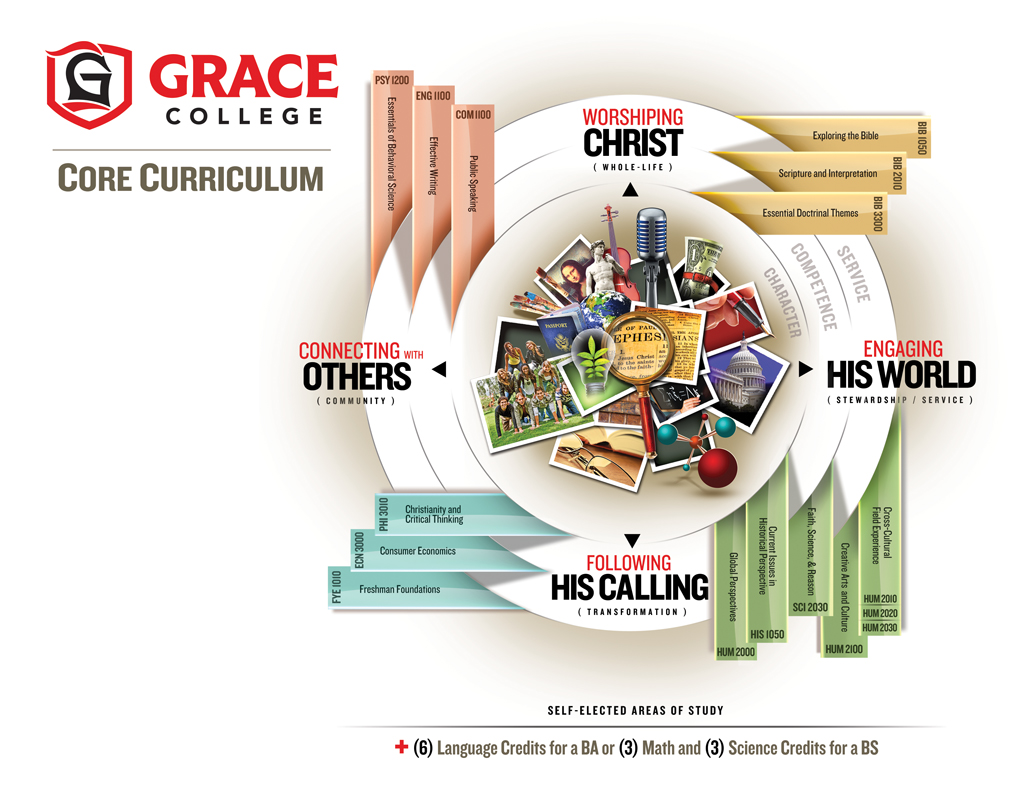
Grace College is a liberal arts institution, which means we are committed to processing information through a Christ-centered worldview, preparing for our careers, engaging well with others, and becoming lifelong learners. This is done through our Grace Core curriculum is a shared educational experience for every Grace undergraduate student and is faithful to the mission and heritage of the college. Here are the four pillars of the Grace Core:

Worshiping Christ

Engaging His World

Following His Calling

Connecting with Others

Why Major in Mathematics? At Grace College we help you find your calling & train you for a career with a Mathematics Degree. Learn more.

The Grace Core aims to inspire transformative learning for all of life’s callings in all of life’s relationships. Through the core, every student completes a series of general education courses that cultivate a Christian understanding of the liberal arts and invite students to reflect upon and engage God’s infallible source of truth as revealed in His Word and through His creation.

Core courses are designed to help students:

  • Develop a Christian worldview
  • Form a biblical foundation
  • Foster a curiosity for learning about the physical and natural world
  • Infuse intellectual and practical skills
  • Encounter world cultures
  • Participate in applied learning experiences

These objectives contribute to developing the whole person for lifelong learning, leading students to respond to Christ’s calling through all of life’s vocations.


Grace College’s - Grace Core Curriculum is designed to help students develop a Christian worldview and form a biblical foundation.

Grace Core Curriculum

FYE provides a space for first-year students to transition into college with an emphasis on meaningful relationships, intentional reflection, and collaborative learning around COMMUNITY, CURIOSITY, and CALLING. Three hours.

A general overview of the Bible which orients the student to the overall presentation of the program of God from the Creation through the Consummation of Christ. Emphasis will be placed on the themes, timeline, structure, and coherence of the entire Biblical revelation. Three hours.

This introductory course in Behavioral Sciences provides an opportunity to learn about the major behavioral science theories, concepts and its real life applications. This course will survey topics such as child development, parenting, gender differences, stress, self-care and abnormal behavior. Students will also be encouraged during this course to increase personal awareness of how cognitive and emotional factors influence behavior in a variety of social contexts. Additionally, this course will examine styles of relating as it pertains to employment, dating, marriage and family life. Three hours

This class examines the historical and political development of at least two broad topics that remain part of contemporary discussion and illustrates the way the past can help students understand current debates and conversations. The topics chosen are meant to represent areas of significant concern for understanding current issues and moral questions. The course asks the question, “How did we get here?” and provides a foundation for discussions of diversity, citizenship, Christian ethics, and cultural awareness. Topics will likely change over time. Three hours.

This course is designed to help you develop and hone the skills necessary for clear and persuasive writing at the college level and beyond. The primary focus of the course is scholarly writing, though we will also explore other genres such as the personal expressive narrative, rhetorical analysis, and position paper. In particular, this course will help you engage complex issues and competing points of view while articulating and supporting an argument using appropriate sources. Three hours.

A study of communication theory as applicable to public speaking. Students explore the components of an effective speech, as well as current applications of speaking skills. Emphasis will placed on practicing and displaying these skills. Three hours.

Foundational principles of effective Bible study will be applied for personal study and small group Bible study leadership. Observational skills of the English text will be developed through hands-on activities and assignments. Hermeneutical principles will be applied to various biblical genres with the goal of equipping the learner to interpret the text based on its historical/cultural and literary context. Application of the meaning of the text for spiritual formation will be emphasized as well. Prerequisite: BIB 105. This course is required in the liberal arts curriculum. Three hours.

An overview of the essential doctrines every Christian should know and be able to articulate and defend. This course will focus on allowing students to engage in collaborative exercises to challenge their thinking and solidify their faith. Three hours.

This course will critically examine the beliefs and presuppositions of philosophers and philosophies over the centuries and their impact on modern Christianity and the Christian Worldview. A critical examination will begin by utilizing the lens of Scripture as the basis of truth in evaluating these beliefs. The application of that examination will be centered on the reasons for God as well as the nature of suffering and evil as learners are encouraged to formulate a biblically sound Christian Worldview. Three Hours.

Consumer Economics is a course designed to prepare students to understand the economic system from a Biblical perspective and how it affects individuals as consumers, producers, and citizens. The Greek word “Oikinomia” can be translated as economics or household management. This course will challenge students to take control of and properly manage the part of God’s creation (household) that he has put in their charge. Students will integrate knowledge and practice the skills required to manage resources in a technologically expanding global economy. Real world topics covered will include economics, personal money management, as well as managing the precious commodities of time, relationships, and spiritual advancement. Three Hours.

The purpose of Global Perspectives is to encounter world cultures through literature, film, and dialogue. In this course, students engage divergent outlooks from around the world, grappling with cultural differences and presuppositions. Defining literary works, films and guest speakers from different continents set the stage for literary and cultural discussions. This course cultivates cultural competency, provides a framework for understanding God’s heart for the nations, and prepares students for the CrossCultural Field Experience. Three Hours.

This course is designed to assist the student in (1) demonstrating the scope and magnitude of science and mathematics; (2) why we study these subjects; (3) knowing the limitations of these subjects; (4) where the Christian fits and operates within the scientific paradigm; and (5) how a Christian can incorporate their faith and reason within the scientific enterprise and how to use it as a productive platform when communicating to those of different worldviews. Three Hours.

Through a global, thematic approach, this course explores the human phenomenon of creativity. Posing the question “Why creative arts?” this course focuses on exploring how culture and creativity reflect each other within the realm of visual and performing arts. Through themes of survival, religion, the state, and self, this course examines artists’ roles within cultures, the way art is made or performed, and how meaning is derived. Required experiential activities for engaging in visual and performing arts include such things as attending museum exhibits, concerts or theatrical productions. Three Hours.

(2010) Students who select the Go Encounter Trip option to fulfill their Cross Cultural Field Experience (CCFE) requirement register for a Go Encounter trip offered by the Grace College Global Initiatives Office. A Go Encounter trip is also worth 2 Applied Learning Credits, which emphasizes “analytic inquiry, active learning, real-world problem solving, and innovation,” (Applied Learning Syllabus). Zero hours.


(2030) A course designed for bicultural individuals for whom the United States is a cross-cultural experience. Students explore some of the assumptions, values and beliefs that characterize the United States and compare those with other cultures. They also discover the third culture, as defined by Dr. Useem, “created, shared, and learned” by those who are from one culture and are in the process of relating to another. Zero hours.